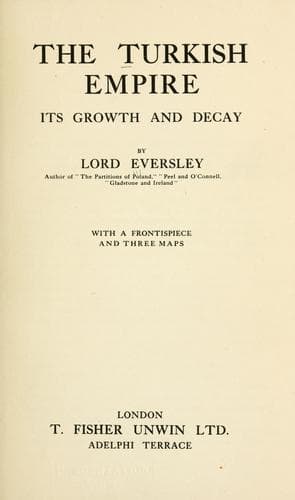
The Turkish Empire, Its Growth and DecayEversley, G. Shaw-Lefevre (George Shaw-Lefevre), Baron
History
The Turkish Empire, Its Growth and Decay
Eversley, G. Shaw-Lefevre (George Shaw-Lefevre), Baron
Turkey -- History
On the conclusion of the campaign of 1687 in Hungary the Turkish
army, as a result of its long series of defeats, was seething with
discontent, and was almost in a state of mutiny. Its leading officers
met and petitioned the Sultan, demanding the dismissal and execution
of its general, the Grand Vizier Solyman. They elected Siawousch
Pasha as their general. The army then retreated across the Danube
to Philippopolis, and thence to Adrianople, from whence it sent a
deputation to the Sultan to enforce its views. The Sultan summoned
a great Council of State, at which it was decided to accede to the
demands of the army. Siawousch Pasha was appointed Grand Vizier in
place of Solyman, who was soon after put to death by order of the
Sultan. It was hoped by this concession to appease the army, and to
prevent its march to Constantinople. The army, however, persisted
in its threatening attitude and renewed its march to the capital.
It now increased its demands. It insisted on the deposition of the
Sultan. There was general concurrence in this among officials at
Constantinople. Mustapha Kiuprili, the brother of the late Ahmed
Kiuprili, who was Kaimachan, and performed the duties of Grand Vizier
in his absence from the capital, called an assembly of ulemas at St.
Sophia. He addressed them in these words:—
Since the Padishah thinks only of diverting himself in the chase, and
at the time when the Empire is assaulted from all quarters we have
seen him dismiss all men capable of repairing our misfortunes, can
you doubt any longer that the dethronement of a Padishah who thus
conducts the affairs of the State is legally permitted?
The ulemas unanimously concurred. They decided on the dethronement
of Sultan Mahomet and his replacement on the throne, not by his son,
but by his legal heir, his next brother, Solyman. They then betook
themselves to the abode in the Seraglio where that prince was secluded,
called him forth, and announced to him their decision, citing in favour
of it a verse from the Koran: “We have named you to be Khaliff of the
country.”
There was no opposition to this. Solyman, who had spent his life in
seclusion, in constant fear of being murdered by his brother, and
who was only saved by the brave efforts of the Sultana Validé, his
mother, came out of what was virtually a prison to be invested with the
insignia of Sultan. Mahomet, who had reigned as Sultan for thirty-nine
years, which he had devoted wholly to the chase, to the neglect of
every duty of his great office, retired to the secluded building which
his brother had occupied so long. He died there a few years later,
regretted by no one.
Public-domain text, read in full here on John Shaqi.
Reviews
Reviews
No reviews yet
Be the first to share your thoughts on this work.
Elsewhere in the archive
Join the Discussion
Join the discussion
Sign in to leave a comment or review.
Sign InorCreate an account