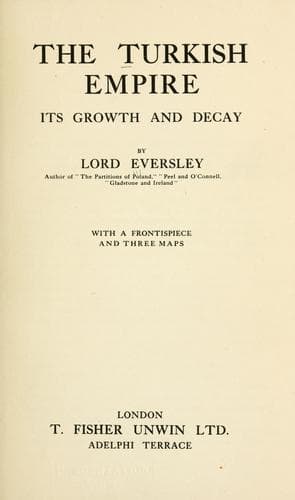
The Turkish Empire, Its Growth and DecayEversley, G. Shaw-Lefevre (George Shaw-Lefevre), Baron
History
The Turkish Empire, Its Growth and Decay
Eversley, G. Shaw-Lefevre (George Shaw-Lefevre), Baron
Turkey -- History
This treaty of Carlowitz was of supreme importance in the international
relations of Europe. It recognized for first time that the status of
the Ottoman Empire was a matter for the concern of all the Powers
of Europe, and not only of those at war with it. It established the
principle of equality of the Powers concerned, and rejected finally
the pretensions of the Ottoman Empire, founded on its long career of
conquest. Thenceforth there was no longer any fear of the invasion of
Central Europe by the Turks. The settlement was not so ignominious to
them as the later treaties of Passarowitch, Kainardji, Adrianople, and
Berlin, but not the less it was a great triumph for the Christian
Powers of Europe. In view of the long series of defeats of the Ottoman
army and the exhausted state of the Empire, Hussein Kiuprili acted
the part of a wise statesman in assenting to the treaty. If his
advice and that of other members of his family had been followed, and
the Christian subjects of the Empire had been treated with justice,
later humiliations might have been avoided, and the Empire might have
survived intact to a much later date.
Hussein Kiuprili retained the post of Grand Vizier for three years
after the treaty of Carlowitz. During this time he showed that he
had most of the qualities of his more distinguished relative, Ahmed
Kiuprili. He was a man of high culture and public spirit. He did his
best by wise and salutary reforms to stem the growing evils of the
State. He aimed at curbing the mutinous power of the Janissaries. He
endeavoured in many ways to improve the deplorable condition of the
rayas. His reforms met with violent opposition from reactionaries. His
health broke down under the stress and he was compelled to resign his
post. He died within a few weeks, in 1702. His reforms did not survive
him. His successor, Daltaban Pasha, was a man of a totally different
type, a savage Serbian, who could neither read nor write, and who had
acquired a reputation for gross cruelty which he fully justified in his
more exalted position.
Once again, in 1710, another member of the Kiuprili family, Nououman
Kiuprili, was appointed Grand Vizier, but though he had many of the
virtues of his race he did not prove to be equal to the post. He
insisted on attempting to do too much. He interfered with every detail
of the State and accumulated the hostility of all his subordinates. The
affairs of the government fell into confusion and he was in consequence
deposed after a very few months. The names of five other members of the
same family appear in the history of the next few years as generals and
governors of provinces.
Public-domain text, read in full here on John Shaqi.
Reviews
Reviews
No reviews yet
Be the first to share your thoughts on this work.
Elsewhere in the archive
Join the Discussion
Join the discussion
Sign in to leave a comment or review.
Sign InorCreate an account