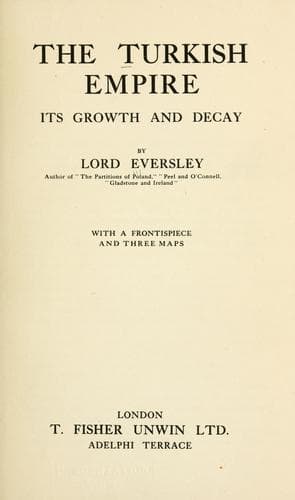
The Turkish Empire, Its Growth and DecayEversley, G. Shaw-Lefevre (George Shaw-Lefevre), Baron
History
The Turkish Empire, Its Growth and Decay
Eversley, G. Shaw-Lefevre (George Shaw-Lefevre), Baron
Turkey -- History
It may be doubted whether in the annals of any country a single family
has produced so many distinguished men, owing their position, not to
personal favour, but to their own merits and to the exigencies of the
State. The case is unique in the history of Turkey, where it would be
difficult to find another instance where two members of any family rose
to distinction.
XIV
TO THE TREATY OF PASSAROWITCH
1702-18
MUSTAPHA did not long survive as Sultan the death of his great Vizier,
Hussein, the fourth of the Kiuprilis. He had not fulfilled the early
expectation of his reign, when, against the advice of the Divan, he
took command of his army in the field. Disappointed and discouraged
by his failure, he fell back on a life of indolence and debauchery.
After the death of Hussein Kiuprili there was widespread discontent
throughout the Empire, and in most parts imminent danger of rebellion.
Mustapha had not the courage to cope with it. He abdicated the throne
and retired voluntarily to the Cage. He was succeeded by his brother,
Achmet III, at the age of thirty, who reigned for twenty-seven years
till he was deposed at the instigation of the Janissaries.
Achmet had not been subjected by his uncle to the customary seclusion.
He came to the throne, therefore, with greater knowledge of the world.
He was not a warrior. He did not attempt to lead his armies in the
field. But he did not allow the affairs of State to fall into the hands
of women of his harem. Neither did he permit ambitious Viziers to
monopolize power. He changed them so often that this was impossible.
During the first fifteen years of his reign there were twelve Grand
Viziers. It was imputed to him that these frequent changes were due
to his want of money and the extravagances of his harem. It was the
custom for Grand Viziers, on their appointment, to make very large
presents in money to the Sultan, and Achmet looked on this as a source
of income. But during their short tenures of office he interfered very
little with them. He was, however, personally in favour of a policy
of peace, and supported his Viziers in its maintenance. The first six
years and the last twelve years of his reign were periods of almost
unbroken peace to the Empire. In the other nine years there were many
important events bearing on the extension or reduction of his Empire.
Territory formerly in the possession of the Ottomans was reconquered,
and provinces long held by them were lost. The city of Azoff and its
adjoining territory—important for the protection of the Crimea—were
recovered from Russia. The Morea and Albania were reconquered from the
Republic of Venice. By agreement with Russia a partition was made of
important provinces belonging to Persia, some of which had formerly
been in the possession of the Porte. On the other hand, as the result
of war with Austria, the remaining part of Hungary, not included in
the cession made by the treaty of Carlowitz, and considerable parts of
Public-domain text, read in full here on John Shaqi.
Reviews
Reviews
No reviews yet
Be the first to share your thoughts on this work.
Elsewhere in the archive
Join the Discussion
Join the discussion
Sign in to leave a comment or review.
Sign InorCreate an account