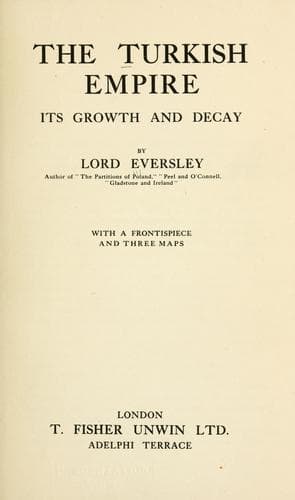
The Turkish Empire, Its Growth and DecayEversley, G. Shaw-Lefevre (George Shaw-Lefevre), Baron
History
The Turkish Empire, Its Growth and Decay
Eversley, G. Shaw-Lefevre (George Shaw-Lefevre), Baron
Turkey -- History
Serbia and Wallachia were lost to the Empire. The gains in territory
exceeded in area the losses. But there can be little doubt that the
loss of prestige by the Ottomans from the defeats of their armies by
the Austrians under Prince Eugène was not compensated for by victories
over the Venetians and Persians, or over the very inferior army of
Peter the Great.
The first of the wars thus referred to was that with Russia, then under
the rule of Peter the Great. He was ambitious of extending his Empire
by the acquisition of the Crimea, and of thus getting access to the
Black Sea. It was only after the defeat of Charles XII, the King of
Sweden, at the battle of Pultowa in 1709, and the consequent conquest
of Livonia, that his hands were free for aggression elsewhere. Russia
was already in possession of the important fortress of Azoff, on the
north-east shore of the sea of that name. The Czar had also fortified
Taganrog and other places threatening the Crimea. The Porte was alarmed
by these manifest preparations for war. The relations of the two
Governments were also embittered by the fact that the Swedish King,
Charles XII, after his defeat at Pultowa, sought refuge in Turkey,
and that the Sultan accorded a generous hospitality to him, and with
great magnanimity refused the demand of Peter for his extradition. It
followed that, in 1711, the Porte anticipated the undoubted hostile
intention of the Czar, and declared war against Russia. An army was
sent by the Sultan across the River Pruth into Moldavia, under command
of Grand Vizier Baltadji. This pasha had risen to his post from the
humble position of woodcutter at the palace, through the intrigues of
his wife, who had been a slave in the Sultan’s harem. The Czar, on his
part, had collected his forces in the south of Poland and marched into
Moldavia. The two armies met on the River Pruth. The Russian army,
already greatly reduced in number by want of food and disease, numbered
no more than twenty-four thousand men. The Ottomans, who had been
reinforced by a large body of Tartars, under the Khan of the Crimea,
were at least five times more numerous. The Czar Peter, unaware that
the Ottomans had crossed the Danube, advanced rashly on the right bank
of the Pruth, and was posted between that river and an extensive marsh
not far from Zurawna. The position was dominated by hills, which the
Grand Vizier occupied in force, and his numerous and powerful guns
swept the position of the Russians, cut off their access to the river,
and completely hemmed them in. Their plight is best described in a
letter which the Czar wrote to the Russian Senate at Moscow from his
camp at this point:—
Public-domain text, read in full here on John Shaqi.
Reviews
Reviews
No reviews yet
Be the first to share your thoughts on this work.
Elsewhere in the archive
Join the Discussion
Join the discussion
Sign in to leave a comment or review.
Sign InorCreate an account