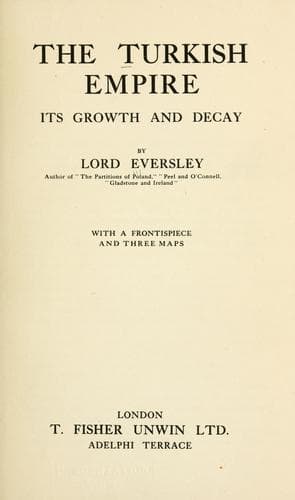
The Turkish Empire, Its Growth and DecayEversley, G. Shaw-Lefevre (George Shaw-Lefevre), Baron
History
The Turkish Empire, Its Growth and Decay
Eversley, G. Shaw-Lefevre (George Shaw-Lefevre), Baron
Turkey -- History
Pacification having thus been effected at the capital, attention was
turned to Persia, where, as has been pointed out, a partition treaty
with Russia had assigned a large part of that kingdom to the Porte,
but the possession of which had not yet been obtained. In the meantime
a brigand chief, Nadir, later to become world-famous as the invader
of India, had taken service under Tahmasp, the son of the dethroned
Hussein. Nadir succeeded in driving the Afghans out of Persia and
reinstating Tahmasp as Shah. He proceeded, however, to usurp the power
of that feeble monarch, and eventually got himself accepted as Shah
in place of Tahmasp. He declared war against the Turks in 1733-5 and,
after defeating them in several engagements, compelled them to sue for
terms of peace. The Porte was the more ready to accede to terms as
war with Russia was imminent. A treaty of peace was therefore agreed
to with Nadir in 1735, under which all the provinces which were the
subject of the partition treaty with Russia were restored to Persia.
Russia also, in prospect of war with Turkey, came to terms with Nadir,
and surrendered nearly all the territory which had been acquired under
the partition treaty with Turkey.
Peter the Great had died in 1727, and in 1730 was succeeded by the
Empress Anne, a clever and ambitious woman. She was incited to war
with Turkey by Marshal Munnich, the ablest general whom Russia so
far had produced. He promised to drive the Turks out of Europe. At
Constantinople the eunuch Bashir was in favour of a policy of peace. He
was over seventy years of age and wished to end his days in repose.
He resisted as far as he could every attempt to draw the Sultan into
war. The French Ambassador, under instructions from his Government,
was most anxious to embroil Turkey with Austria. The two maritime
Powers, however—Great Britain and Holland—pulled in the opposite
direction, and peace was maintained as long as possible. But when, in
1735, the Russians, though nominally at peace with Turkey, captured
two fortresses in the neighbourhood of Azoff and threatened that most
important outpost of the Empire, the Porte declared war. A Russian
army of fifty-four thousand men, under command of Marshal Munnich,
then invaded the Crimea. They stormed and broke through the fortified
lines of Perekop at the isthmus of that name, joining the Crimea to the
mainland, hitherto thought to be impregnable. They captured the city
of Perekop, and then overran the whole of the Crimea, devastating it
and massacring its inhabitants by thousands. The Russian army, however,
suffered greatly from exhaustion and disease in the campaign, and it
eventually withdrew from the Crimea before the winter. Another Russian
force, under General Leontiew, captured Kilburn, and a third, under
General Lascy, an Irishman by birth, attacked and captured the city of
Azoff.
Public-domain text, read in full here on John Shaqi.
Reviews
Reviews
No reviews yet
Be the first to share your thoughts on this work.
Elsewhere in the archive
Join the Discussion
Join the discussion
Sign in to leave a comment or review.
Sign InorCreate an account