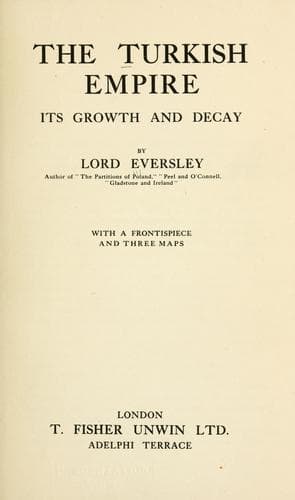
The Turkish Empire, Its Growth and DecayEversley, G. Shaw-Lefevre (George Shaw-Lefevre), Baron
History
The Turkish Empire, Its Growth and Decay
Eversley, G. Shaw-Lefevre (George Shaw-Lefevre), Baron
Turkey -- History
Meanwhile the Russian diplomatists discovered that the Emperor of
Austria, Charles VI, was quite as anxious as the Czarina Anne to
possess himself of Turkish provinces, and was ready to enter into a
coalition for the purpose. In the winter of 1736-7 a secret treaty for
this purpose was entered into between the two potentates. But as it
was not thought expedient by the Austrians to commence their attack
until all their preparations for it were completed, a pretence was
made of negotiations with the Porte, who had made overtures of peace
to the Russians. For this purpose a Congress was held at Nimirof early
in 1737. Later it became known that the negotiations on the part of
the two allied Empires were illusory, and that there never was any
intention to come to terms. The Porte, on its part, was extremely
anxious for peace, and was ready to make large concessions, but the
terms suggested on behalf of Russia were so extortionate that it was
quite impossible for the Sultan and his ministers to entertain them.
The Russians demanded the cession of the Crimea, the independence of
Wallachia and Moldavia under a native prince, subject to the supremacy
of Russia, the opening of the Black Sea and access to it through the
Bosphorus and the Dardanelles to Russian vessels of war, and the
payment of fourteen millions of roubles. Austria, on its part, demanded
the cession of the whole of Bosnia and Serbia. Such terms could only
be assented to by the Porte after complete and disastrous defeat. They
were indignantly rejected, and, much against the wish of the Porte, the
Congress came to an end, and the Sultan was forced to take up arms in
defence of his Empire.
A Russian army of seventy thousand men, under Marshal Munnich, opened
the campaign of 1737 by an attack on Oczakoff, the most important of
the Ottoman fortresses on the northern shores of the Black Sea, and
General Lascy, with forty thousand men, again invaded the Crimea.
Oczakoff was vigorously defended by twenty thousand Turks. After some
days of siege the principal powder magazine in the fortress blew up,
causing enormous destruction and loss of life. The Turkish general,
dismayed by this, capitulated on favourable terms. But this did not
prevent the massacre of the greater part of the garrison, and only
three thousand of them survived. The losses of the Russians, chiefly by
disease, were also very great, and nothing more was done by Munnich in
this year’s campaign. Meanwhile Lascy in the Crimea had repeated the
operation of Munnich of the previous year, and eventually retreated
from it.
The Austrians, on their part, invaded Bosnia and Serbia with two
armies. The principal one, under General Seckendorf, attacked and
captured Nisch and, later, Widdin. But this exhausted their efforts for
the year, and most of their army perished from disease in the marshes
of the Danube.
Public-domain text, read in full here on John Shaqi.
Reviews
Reviews
No reviews yet
Be the first to share your thoughts on this work.
Elsewhere in the archive
Join the Discussion
Join the discussion
Sign in to leave a comment or review.
Sign InorCreate an account