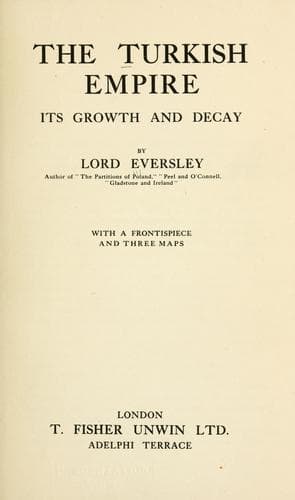
The Turkish Empire, Its Growth and DecayEversley, G. Shaw-Lefevre (George Shaw-Lefevre), Baron
History
The Turkish Empire, Its Growth and Decay
Eversley, G. Shaw-Lefevre (George Shaw-Lefevre), Baron
Turkey -- History
These repeated successes of the Russians began to cause alarm
to Austria and Prussia, who by no means wished for the undue
aggrandizement of their neighbour. They therefore attempted
negotiations with Russia for mediation on behalf of the Ottoman
Empire. But the Empress Catherine obstinately resisted anything in
the way of interference by other Powers, and made it known to the
Sultan that terms of peace must be settled with herself alone. In his
desperation the Sultan proposed to Austria a joint partition of Poland
as a bribe for assistance against Russia, oblivious of the fact that
he had entered upon war with Russia on behalf of Poland. The offer
was declined by the Emperor, not because he had any objection to a
scheme of plunder, but because he did not consider the Porte to be in a
position to become an effective partner in such a scheme. As a matter
of fact, Austria, Russia, and Prussia were continually negotiating
schemes for the dismemberment either of Poland or Turkey, as might be
most convenient to them.
At the end of the campaign of 1771 an armistice was agreed to between
Russia and the Porte, and the greater part of the following year was
occupied in discussing terms of peace at a conference or congress at
Bucharest. An ultimatum was eventually presented by Russia, embodying
terms of what might seem to be a very moderate character, in view of
the great success of her armies and the extent of territories which
they had practically conquered. The Sultan himself and his Grand Vizier
and principal ministers and generals were in favour of accepting the
terms as offered, but the Mufti and the whole body of the ulemas were
vehemently opposed to them. The Divan therefore rejected them and war
was renewed. As these terms did not substantially differ from those
which were accepted two years later, it is not worth while at this
stage to explain them.
Meanwhile there had been for more than a year a suspension of
hostilities, and a breathing time had been afforded to the Porte,
during which strenuous efforts were made for another campaign. At the
end of 1772, Mouhsinzade Pasha, who had so distinguished himself in the
defence of the Morea, was again appointed Grand Vizier. He infused new
vigour into the army. In the spring of 1773, when the negotiations at
Bucharest were brought to a conclusion, hostilities were recommenced.
The campaign in Europe, in this year, was confined within the
quadrilateral formed by the fortresses in Silistria and Rustchuk on
the Danube, the city of Varna on the Black Sea, and the great fortress
of Schumla to the north of the Balkan range. There were several
engagements between divisions of the two armies in this district, in
which the Turks were generally worsted, but these victories were not
of much avail to the Russians so long as the three great fortresses of
Silistria, Varna, and Schumla remained in the hands of the Turks.
Public-domain text, read in full here on John Shaqi.
Reviews
Reviews
No reviews yet
Be the first to share your thoughts on this work.
Elsewhere in the archive
Join the Discussion
Join the discussion
Sign in to leave a comment or review.
Sign InorCreate an account