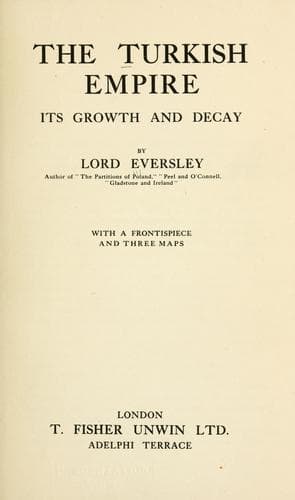
The Turkish Empire, Its Growth and DecayEversley, G. Shaw-Lefevre (George Shaw-Lefevre), Baron
History
The Turkish Empire, Its Growth and Decay
Eversley, G. Shaw-Lefevre (George Shaw-Lefevre), Baron
Turkey -- History
The two main features of the campaign were the successful defences
by the Turks of Silistria and Varna against overwhelming forces of
Russians. General Romanzoff crossed the Danube early in the year near
Silistria. He defeated a Turkish division and compelled it to retreat
to that fortress, where it added to its garrison. Romanzoff then laid
siege to it. His army stormed the outer defences with the utmost
vigour and succeeded in forcing them. But their difficulties only then
commenced. The Turks, under command of Osman Pasha, maintained an
heroic resistance. The whole male population turned out in aid of the
army. They fought the advance of the Russians street by street. In the
end the Russians were compelled to retreat, after the loss of eight
thousand men. Later, Romanzoff inflicted a severe defeat on the Turks
at Korason. This opened the way to Varna. But here again a successful
defence was offered by the Turkish garrison, supported by the seamen of
the Ottoman fleet in the Black Sea. This was the closing scene of the
campaign of 1773. Sultan Mustapha died towards the close of this year,
and was succeeded by his brother, Abdul Hamid, who had been secluded
in the Cage for forty-eight years. As was to be expected, he showed
no capacity for the position to which he was now at last called. He
was, however, favourable to peace, as was also Mouhsinzade, who was
maintained as Grand Vizier.
At the commencement of the campaign of 1774 the Grand Vizier issued
from his camp at Schumla with twenty-five thousand men, with the
intention of taking the offensive and attacking the Russians at
Hirsova, on the Danube. The Russian forces in that district were under
command of Suvorov, who now and later was to show himself the greatest
general Russia had as yet produced. He did not wait to be attacked by
the Turks. He advanced from Hirsova and met the Grand Vizier’s army
at Kostlidji, where he gained an overwhelming victory. The Turkish
camp and all its guns and stores were captured. The defeated army
dispersed, and the Grand Vizier found himself with only eight thousand
men to defend Schumla. The Russians manœuvred so as to cut off the
communications of Schumla with the capital. Mouhsinzade thereupon asked
for an armistice. This was refused by the Russians, but they were
willing to discuss terms of peace. The assent of the Porte was obtained
by the Grand Vizier, and on July 16, 1774, after seven hours only of
discussion between plenipotentiaries at the village of Kainardji, a
treaty of peace was agreed to.
Public-domain text, read in full here on John Shaqi.
Reviews
Reviews
No reviews yet
Be the first to share your thoughts on this work.
Elsewhere in the archive
Join the Discussion
Join the discussion
Sign in to leave a comment or review.
Sign InorCreate an account