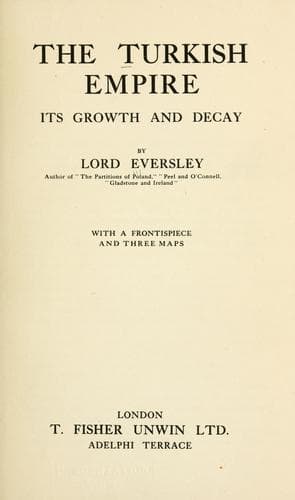
The Turkish Empire, Its Growth and DecayEversley, G. Shaw-Lefevre (George Shaw-Lefevre), Baron
History
The Turkish Empire, Its Growth and Decay
Eversley, G. Shaw-Lefevre (George Shaw-Lefevre), Baron
Turkey -- History
The terms were almost identical with those which had been rejected by
the Porte two years before, after the conference at Bucharest. In view
of the fact that the Ottoman armies had been everywhere defeated during
the war, and that the Russians had obtained actual possession of the
Crimea, Wallachia, Moldavia, and Bessarabia in Europe, and of Georgia
and Mingrelia in the Caucasus, the terms were distinctly moderate. The
Empress must have been very desirous of peace. There was a serious
rebellion of her southern provinces. Affairs in Poland were causing
her great anxiety. Her losses in the war with Turkey had been very
great, though her victories were many. It was all-important to her that
her hands should be free. These were doubtless adequate reasons for
moderation in her terms to Turkey.
Under this treaty Russia gave up nearly all the Turkish territory
occupied by her armies. The Crimea was not, indeed, restored to the
Turks. The independence of the Tartars there and in Bessarabia up to
the frontier of Poland was recognized under a native prince, in whose
election Russia and Turkey were forbidden to interfere. Neither Power
was thenceforth to “intervene in the domestic, political, civil, and
internal affairs of this new State.” There was, however, a grave
reservation pregnant of future aggrandizement to Russia. She was to
retain the fortresses of Kertch, Yenikale, and the cities of Azoff and
Kilburn. These would necessarily give access to and virtual command
over the Crimea to Russia at any future time. For the present, however,
the Crimea, though lost to the Turks, was not acquired by Russia. It is
probable that the ulemas would not have assented to the transfer of a
Moslem province to a Christian Power, and that the war would have been
continued if Russia had insisted on this. Oczakoff, on the opposite
side of the Dnieper to Kilburn, was retained by the Porte. But the two
Karbartas on the shores of the Euxine, though inhabited by Moslems,
were retained by Russia. With these exceptions, all the Ottoman
territories in the hands of Russia as a result of the war—Wallachia,
Moldavia, Bessarabia, Georgia, and Mingrelia—were restored to the
Sultan. In the case of Wallachia and Moldavia, this retrocession
was subject to the condition that free exercise of the Christian
religion was to be secured to their population, and that there was to
be humane and generous government there for the future. The right of
remonstrance in these respects was secured to the ministers of Russia
at Constantinople on behalf of these provinces.
Another most important clause, full of danger for the future to the
Ottoman Empire, related to its Christian subjects. “The Sublime Porte,”
it ran, “promises to protect constantly the Christian religion and
churches and allow the ministers of Russia at Constantinople to make
representation on their behalf.”
Public-domain text, read in full here on John Shaqi.
Reviews
Reviews
No reviews yet
Be the first to share your thoughts on this work.
Elsewhere in the archive
Join the Discussion
Join the discussion
Sign in to leave a comment or review.
Sign InorCreate an account