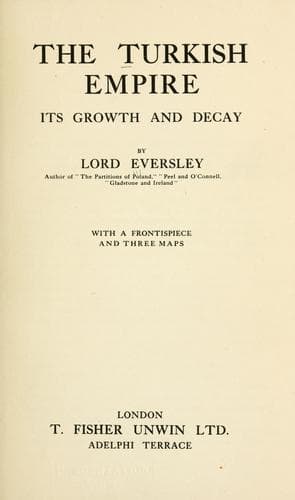
The Turkish Empire, Its Growth and DecayEversley, G. Shaw-Lefevre (George Shaw-Lefevre), Baron
History
The Turkish Empire, Its Growth and Decay
Eversley, G. Shaw-Lefevre (George Shaw-Lefevre), Baron
Turkey -- History
The Empress made a triumphal progress through the Crimea, under the
auspices of her favourite and paramour, Prince Potemkin, to whose
efforts its annexation had been mainly due. The Emperor Joseph met her
on the way there at Kherson, and hatched with her a scheme of war with
Turkey. A triumphal arch was erected, with the inscription, “This is
the way to Byzantium.” Emissaries were sent to stir up rebellion in
Wallachia and Moldavia. Claims were raised officially against Turkey
for the province of Bessarabia and the fortress of Oczakoff, on the
ground that they had formerly been part of the domains of the Khans of
the Crimea. These claims greatly irritated the Turks. The few years
of peace had renovated them. They were now ambitious of recovering
the city of Kilburn, and even had hopes of regaining the Crimea.
Popular feeling was aroused, and at the instance of the Divan, and
without waiting to make preparations for the defence of the frontier
fortresses, the Sultan declared war against Russia on August 15, 1787.
A large force was then sent by the Porte to Oczakoff, the fortress
on the embouchure of the Dniester, with the intention of attacking
Kilburn on the opposite side. A fleet was sent, under Hassan, to
co-operate with it, and to convey the army across the river to
Kilburn. Unfortunately for the Turks, the Russian force at Kilburn
was under the command of Suvorov, a military genius of the first
rank. He allowed the larger half of the Turkish army to be conveyed
across the river and then attacked it by land, while a flotilla of
gunboats from Nicholaif engaged the Turkish fleet. This strategy was
completely successful. The Ottoman force of eight thousand men landed
on the Kilburn side was overwhelmed and slaughtered. Nearly the whole
of Hassan’s fleet was destroyed. The attack on Kilburn was completely
defeated.
Nothing more was effected by either of the two combatants in 1787.
At the beginning of the next year, 1788, the Emperor of Austria, on
February 10th, declared war against Turkey without any provocation.
He had been delayed fulfilling his agreement with Catherine by
disturbances in his own dominions. He was now free to carry out his
undertaking. The Turks, therefore, found themselves confronted by two
formidable enemies. Fortunately for them, Russia was prevented putting
forth its full strength in the south, in consequence of war having
broken out with Sweden. The Empress was unable on this account to carry
out her engagement with the Emperor to send an army into Moldavia in
support of that of the Austrians. Nor was she able to send a fleet into
the Ægean Sea, as had been promised. But Joseph took command himself
of an army of two hundred thousand men with which to attack the Turks.
He soon proved himself to be the most incompetent of generals. The
only defeat he was able to inflict was upon his own soldiers, under
circumstances unprecedented in war.
Public-domain text, read in full here on John Shaqi.
Reviews
Reviews
No reviews yet
Be the first to share your thoughts on this work.
Elsewhere in the archive
Join the Discussion
Join the discussion
Sign in to leave a comment or review.
Sign InorCreate an account