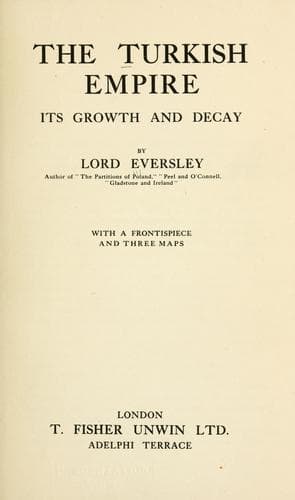
The Turkish Empire, Its Growth and DecayEversley, G. Shaw-Lefevre (George Shaw-Lefevre), Baron
History
The Turkish Empire, Its Growth and Decay
Eversley, G. Shaw-Lefevre (George Shaw-Lefevre), Baron
Turkey -- History
The campaign of the following year was far more disastrous to the
Turks. Early in 1789 Sultan Abdul Hamid died, and was succeeded by his
nephew, Selim III, a young man of twenty-seven, of vigour and public
spirit. He had not been subjected by his uncle, Abdul Hamid, to the
debasing seclusion which had for so long been the fate of heirs to the
throne. He had been allowed much freedom. His father, Mustapha, had
left him a memoir, pointing out the dangers of the State, and advising
extensive reforms, and the young man had deeply studied this. He was
fully conscious of the necessity for radical changes, and though he
very wisely did not attempt to lead his troops in the field, he spared
no effort to improve the condition of the army and to stimulate the
warlike zeal of his subjects. He sent the immense accumulation of plate
in his palace to the Mint, and he persuaded the ladies of the harem
to give up their jewellery in aid of the treasury. He was ardently in
favour of reforms in all directions. He deserved a better fate than was
in store for him. It will be seen that his reign was one of most bitter
reverses.
Unfortunately for the Turks, ill-health prevented the Emperor Joseph
from again taking the field in command of the Austrian army. He
was replaced by Marshal Loudon—a veteran of the Seven Years War, a
Scotsman by race, who had risen from the ranks and had deservedly
won great reputation. It was said of him that he “made war like a
gentleman.” He was noted for his quick decision on the field of
battle, and though over seventy-five was still in full vigour. A
new spirit was infused into the Austrian army. A part of it under
Marshal Loudon invaded Bosnia and Serbia, where it met with brilliant
success. In Bosnia it was stoutly resisted by the Moslem population.
In Serbia it met with cordial co-operation of the rayas, who detested
their Moslem oppressors. The greater part of these two provinces was
occupied. Another Austrian army, under the Prince of Coburg, was
directed to Moldavia to act in concert with the Russian army, under
Suvorov. The Sultan, on his part, appointed Hassan as Grand Vizier
and commander-in-chief of the army. Hassan was not equal to the task
of confronting such a general as Suvorov. He advanced with a large
army against Coburg, who was stationed at Fokshani, on the frontier
of Moldavia. Coburg would have been overwhelmed by the superior force
of the Turks had it not been for the wonderful activity of Suvorov,
who marched sixty miles through a difficult and mountainous country in
thirty-six hours to relieve the Austrians. Suvorov, immediately on
arrival, late in the afternoon, made preparations for attacking the
Ottoman army. Two hours before daylight the next day he assaulted the
fortified camp of the Turks. Never was a bold course more completely
justified. The camp was carried by the Russians with the bayonet. The
Turks lost all their artillery and immense stores. Another great army
Public-domain text, read in full here on John Shaqi.
Reviews
Reviews
No reviews yet
Be the first to share your thoughts on this work.
Elsewhere in the archive
Join the Discussion
Join the discussion
Sign in to leave a comment or review.
Sign InorCreate an account