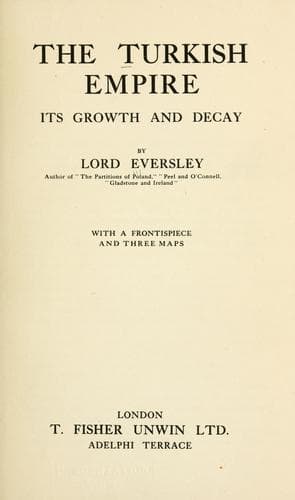
The Turkish Empire, Its Growth and DecayEversley, G. Shaw-Lefevre (George Shaw-Lefevre), Baron
History
The Turkish Empire, Its Growth and Decay
Eversley, G. Shaw-Lefevre (George Shaw-Lefevre), Baron
Turkey -- History
was sent by Selim and was also utterly defeated by Suvorov on the
River Rimnik in September of the same year.
These two serious defeats caused panic at Constantinople. To allay this
the Sultan, to his infinite discredit, gave orders for the execution
of the brave old Hassan—the victor in so many battles, whose advice
for the better training of the Janissaries had been cruelly neglected.
But it was the habit of the Turks to attribute every defeat to the
treason of the general and to put him to death, just as the Convention
at Paris, during the revolutionary wars, sent to the guillotine the
generals who failed—not, it must be admitted, without some result in
stimulating others to better efforts.
Farther to the west, Belgrade and Semendria were captured by the
Austrians in this campaign of 1789. In the following year the tide of
victory on the part of the Russians and Austrians was stayed by two
events. The one was that the Emperor Joseph found it necessary, in
consequence of outbreaks in almost every part of his own dominions,
caused by his hasty and ill-considered measures of centralization, in
defiance of all local customs, to hold his hand against the Turks, and
withdraw his conquering armies in order to employ them in putting down
revolution at home. His death occurred early in 1790. Leopold, who
succeeded, a wise and sagacious ruler, the very opposite to Joseph,
reversed the policy of his brother. He did not favour a Russian
alliance against Turkey.
Another cause of Austria withdrawing from the war was the entry into
the field of politics in the east of Europe of England, Prussia,
and Holland. These Powers had formed a close defensive alliance,
and had already exercised great influence by joint action. They had
extinguished French influence in Holland. They had intervened with good
effect between Russia and Sweden and had brought about peace between
them. They now proposed mediation between Austria and Turkey, not
without threats of stronger action. An armistice was agreed to between
these Powers. The death of Joseph greatly facilitated an arrangement.
Terms were agreed upon with the Turks, and were ultimately embodied
in the treaty of Sistova, on the principle of the _status quo_ before
the war, under which all the territory which Austria had occupied in
Bosnia, Serbia, and Wallachia, including the fortresses of Belgrade and
Semendria, were given back to Turkey, with the exception of a small
strip of land in Croatia and the town of Old Orsova. The acquisitions
by Austria were of very small importance and made but a poor return for
the great effort put forth in the war. But the new Emperor, Leopold,
did not think that Austria had anything to gain by the dismemberment
of either Turkey or Poland. Had he lived, subsequent events might have
turned out differently, and Poland, in all probability, would not have
been victimized.
Public-domain text, read in full here on John Shaqi.
Reviews
Reviews
No reviews yet
Be the first to share your thoughts on this work.
Elsewhere in the archive
Join the Discussion
Join the discussion
Sign in to leave a comment or review.
Sign InorCreate an account