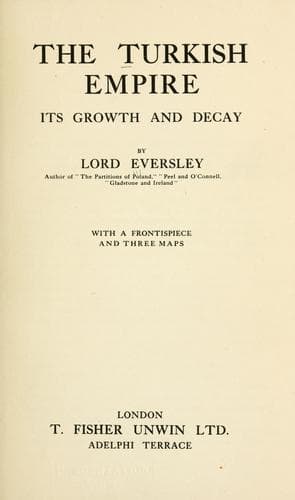
The Turkish Empire, Its Growth and DecayEversley, G. Shaw-Lefevre (George Shaw-Lefevre), Baron
History
The Turkish Empire, Its Growth and Decay
Eversley, G. Shaw-Lefevre (George Shaw-Lefevre), Baron
Turkey -- History
Apart from this great achievement, he showed inflexible firmness
and courage in the great difficulties which confronted him, and
almost alone he bore the burden of the State for thirty-one years of
unparalleled peril, and often of most serious disaster. It will be seen
that, in spite of these high qualities, and in spite of the reform of
his army, the losses of territory to his Empire were very serious. In
Greece, the Morea, and the provinces north of the Gulf of Corinth up
to the frontier of Thessaly, acquired complete independence under the
guarantee of the three Great Powers of Europe. Egypt, Moldavia and
Wallachia, and Serbia attained almost similar independence, subject
only to the nominal suzerainty of the Sultan of Turkey and the payment
of fixed tributes. They no longer added to the real strength of the
Empire. On the other hand, he completely destroyed the power of the
rebellious Pashas of Janina, Widdin, Bagdad, and Acre, and through
Mehemet Ali, the Pasha of Egypt, he subdued the Wahabees and recovered
the holy cities of Mecca and Medina.
It should be added that Mahmoud, unlike so many of his predecessors,
devoted his life to affairs of his State rather than to his harem. He
committed at times acts of great cruelty. He put to death his brother
Mustapha and Mustapha’s only son, and caused to be drowned in the
Bosphorus four ladies of Mustapha’s harem who were enceinte. He had no
scruple in directing the secret assassination of any persons whom he
suspected of harbouring schemes in opposition to his own. He authorized
the perpetration of ruthless massacres of Greeks in all parts of his
Empire at the inception of the revolution in Greece. But these were
acts of policy in accord with the traditions of his family, approved
by public opinion of the Turks, by whom terrorism and massacre were
recognized as justifiable methods of government. The murder of his
relatives left him the sole survivor of the Othman race, a position
which secured him from intrigues against his throne by the Janissaries.
The most serious of the losses to the Empire in Mahmoud’s reign was
that of Egypt, for it was a Moslem country, and though for many years
previously the hold on it by the Ottoman Porte had been slender, and
the Mamelukes had been able, as a rule, to impose their will and
to govern the province, yet the Porte could in the main rely on it
for support to the Empire in times of emergency. It will be well,
therefore, to explain the changes effected in Egypt, for it will be
seen that they had a great bearing on events in other parts of the
Ottoman Empire.
Public-domain text, read in full here on John Shaqi.
Reviews
Reviews
No reviews yet
Be the first to share your thoughts on this work.
Elsewhere in the archive
Join the Discussion
Join the discussion
Sign in to leave a comment or review.
Sign InorCreate an account