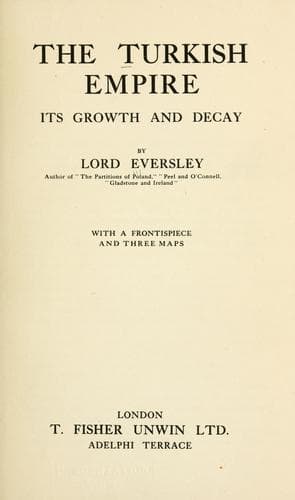
The Turkish Empire, Its Growth and DecayEversley, G. Shaw-Lefevre (George Shaw-Lefevre), Baron
History
The Turkish Empire, Its Growth and Decay
Eversley, G. Shaw-Lefevre (George Shaw-Lefevre), Baron
Turkey -- History
There was no great zeal for the defence of the capital. The chief
ministers of the Porte were unanimous in advising the Sultan to sue
for terms of peace. They were quite ignorant of the weakness of the
Russian army. They believed the stories that more than a hundred
thousand men were advancing on the capital. There were no troops at
Constantinople, they said, able to meet this army. The ambassadors of
England and France, who had recently returned to Constantinople, at the
invitation of the Sultan, backed up the ministers, and urgently advised
him to come to terms with the enemy. We now know that all this advice
and these alarms were founded on false information and that there was
no real justification for them. In fact, the real position of the
Russian army was one of extreme danger. It had suffered great losses
on the battlefields and from the hardships of the forced marches, and
was also being decimated by disease. There was no possibility of its
being reinforced. Retreat across the Balkans was almost impossible.
The Turkish army at Schumla was now reinforced. On its flank there
was an army of twenty thousand Albanians, under the rebellious Pasha
of Scotra, who had refused aid to the Porte in the earlier part of
the campaign, but who, now that the existence of the Empire was
threatened, might confidently be expected to come to its aid. Advance
to Constantinople might also be dangerous, if not impossible. It was
distant one hundred and forty miles. Its garrison of thirty thousand
men, supplemented by fresh volunteers, might be relied on to meet
the Russians, now reduced to much less than twenty thousand. These
difficulties of the Russian army, however, were not known to the Porte.
In view of the strong pressure brought to bear upon him, the Sultan,
for once in his life, gave way, and agreed to send plenipotentiaries to
Adrianople to discuss terms of peace. Diebitsch well knew the danger
of his position, and was anxious to make peace, but he maintained an
attitude of firmness and confidence. He was ready, he said, to discuss
terms, but he was equally willing to advance with his army against the
capital. Already a part of his army was pressed forward. It occupied a
line from the Black Sea at Kilia to Enos in the archipelago—a distance
of over one hundred miles, much too long for his weak force. It is
recognized by Moltke and all military authorities that if the Porte had
stood firm and had refused to agree to terms, Diebitsch could not have
made good his threatened attack on the capital. In the history of war
there has never been a more successful case of ‘bluff.’ The Porte gave
in to unreasoning and ill-informed fear, and on September 19th peace
was concluded between the two Powers and the treaty of Adrianople was
signed.
Public-domain text, read in full here on John Shaqi.
Reviews
Reviews
No reviews yet
Be the first to share your thoughts on this work.
Elsewhere in the archive
Join the Discussion
Join the discussion
Sign in to leave a comment or review.
Sign InorCreate an account