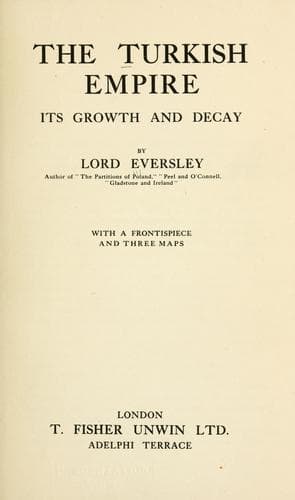
The Turkish Empire, Its Growth and DecayEversley, G. Shaw-Lefevre (George Shaw-Lefevre), Baron
History
The Turkish Empire, Its Growth and Decay
Eversley, G. Shaw-Lefevre (George Shaw-Lefevre), Baron
Turkey -- History
It is certain [said Moltke] that this treaty released Diebitsch from
a position as perilous as could well be conceived, and which, if
prolonged for a few more days, might have caused him to be hurled
down from the summit of victory to the lowest depth of ruin and
destruction.[33]
The terms of peace agreed to were moderate, so far as Russia itself
was concerned, though very serious in their effect on the Ottoman
Empire. The Czar had proclaimed at the outset of the war that he had
no desire for territorial aggrandizement. He fully adhered to this
promise. With two comparatively small exceptions, Russia gave up all
the territory which it had conquered in the war, both in Europe and
Asia. It retained only a small part of Moldavia which gave access to
the Sulina mouth of the Danube, a position of great importance to it
in the future. In Asia, Kars and Erzerum were given back to Turkey.
In Europe, the Pruth continued to be the boundary of the two States.
But Moldavia and Wallachia, though nominally restored to the Ottoman
Empire, were practically freed from it. They were to enjoy complete
autonomy. The Hospodars, in future, were to be appointed for life.
The two States were to be allowed to raise armies independent of the
Porte. The tribute payable in future was to be fixed, and could not
be increased. Religious and commercial freedom were to be secured to
them. The Sultan was to be their suzerain and nothing more. This meant
practical independence. The same privileges were secured for Serbia,
with the exception that the Porte was to be permitted to garrison the
fortresses of Belgrade and Orsova. The Turks were required to depart
from all other parts of the country. Silistria was to be returned to
Turkey, but other fortresses on the Danube were to be razed. That
river, therefore, ceased to be the first defence of the Turkish Empire
to the north. An indemnity of eleven and a half million ducats, equal
to five millions sterling, was to be paid by Turkey for the expenses of
Russia in the war. The payment was to be spread over ten years, and the
territory occupied by Russia was not to be wholly surrendered till this
was effected.
Public-domain text, read in full here on John Shaqi.
Reviews
Reviews
No reviews yet
Be the first to share your thoughts on this work.
Elsewhere in the archive
Join the Discussion
Join the discussion
Sign in to leave a comment or review.
Sign InorCreate an account