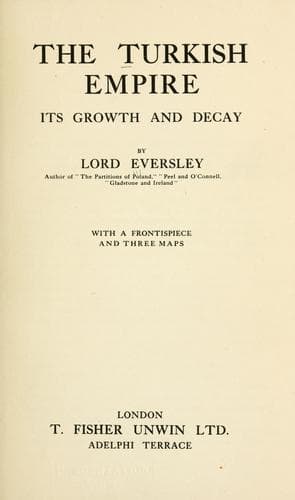
The Turkish Empire, Its Growth and DecayEversley, G. Shaw-Lefevre (George Shaw-Lefevre), Baron
History
The Turkish Empire, Its Growth and Decay
Eversley, G. Shaw-Lefevre (George Shaw-Lefevre), Baron
Turkey -- History
The Sultan agreed to this new project. He probably preferred a
smaller Greece with complete independence to a larger one with full
autonomy, subject to his suzerainty. Greece was accordingly recalled
into national existence with a greatly reduced area, leaving outside
large districts with completely homogeneous Greek populations. This
was fraught with grave difficulties in the future. One effect of it
was that Prince Leopold of Saxe-Coburg, who, later, as King of the
Belgians, proved to be one of the most able rulers of his day, refused
to accept the throne of Greece on the ground that its area was too
restricted, and Otho, a son of the King of Bavaria, was selected
by the Powers for the post, and proved to be a most incompetent
and reactionary ruler. It would seem that Lord Aberdeen, who was
Minister of Foreign Affairs in England at the time, and who was mainly
responsible for these changes, was anxious to restrict the kingdom of
Greece to the smallest possible area.
Reverting to the treaty of Adrianople, it is to be observed that while
Russia acquired a very insignificant extension of territory, and was
content with the prestige of having dictated its terms, and with
having acquired a position such that it might insist on its behests
to the Porte, as regards its Christian subjects, being obeyed in the
future, Turkey lost very greatly. It was said that the Sultan, after
signing the treaty, shut himself up in his palace at Therapia for
weeks in gloomy despair. There was much cause for this. The treaty
was a complete surrender of all that he had been contending for since
his accession to the throne. It was humiliating to himself and his
Turkish subjects. It was the inevitable precursor of much that was to
occur to other parts of his Empire. His grief and indignation must
have been greatly aggravated when he came to know the real condition
of the Russian army at Adrianople and to appreciate that, if he
had stood firm in resisting the advice of his ministers and of the
ambassadors, the Russian army would have been quite unable to make an
advance against Constantinople. This, however, should not lead us to
forget the supreme error which Mahmoud committed in refusing to come
to terms with the three Powers as regards Greece after the treaty of
London. If in 1827, the Sultan had been willing to make concessions in
the direction of autonomy to Greece, it is nearly certain that there
would have been no declaration of war on the part of Russia, and in the
event of war he would not have been wanting in allies. His fleet would
not have been destroyed at Navarino, and time would have been afforded
to him to reorganize his army and to make it effective against those
of the Christian Powers. As it was, not only did he lose all real hold
over Moldavia, Wallachia, and Serbia, not only did Greece gain its
independence, but he was soon to lose all real authority in Egypt, a
Moslem country, except the barren right of suzerainty of the Sultan and
Public-domain text, read in full here on John Shaqi.
Reviews
Reviews
No reviews yet
Be the first to share your thoughts on this work.
Elsewhere in the archive
Join the Discussion
Join the discussion
Sign in to leave a comment or review.
Sign InorCreate an account