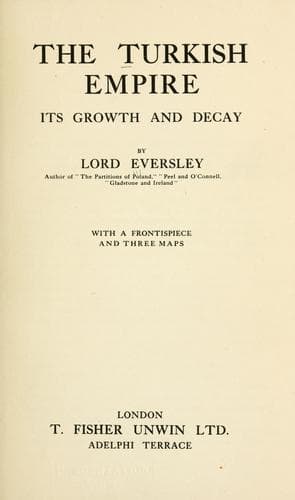
The Turkish Empire, Its Growth and DecayEversley, G. Shaw-Lefevre (George Shaw-Lefevre), Baron
History
The Turkish Empire, Its Growth and Decay
Eversley, G. Shaw-Lefevre (George Shaw-Lefevre), Baron
Turkey -- History
a fixed tribute in money.
It has already been stated that when, in 1824, the Sultan invited
the aid of the Pasha of Egypt to crush rebellion in Greece, Mehemet
Ali only consented to lend his army and fleet on the express promise
that the Pashalics of Syria, Damascus, Tripoli (in Asia), and Crete
would be given to him, in addition to that of Egypt. But when in 1827,
after the destruction of the Turko-Egyptian fleet at Navarino and the
expulsion of the Egyptian army from the Morea, Mehemet Ali pressed for
the performance of this promise, he met with a blank refusal, except as
regards the island of Crete, the Pashalic of which alone was conferred
on him. Mehemet was very indignant at this breach of promise, and
determined to seize by force the provinces which he coveted. He set to
work with great resolution to build another fleet, in place of that
which had been burnt or sunk, and to improve and strengthen his army.
By 1832 he completed these preparations for war. He then picked a
quarrel with the Pasha of Syria and, pretending to make war against
him and not against the Sultan, sent an army, under Ibrahim, across
the desert into Syria. It captured Gaza and Jerusalem without
difficulty, and then marched to Acre, where the Egyptian fleet met it
and co-operated in a successful attack on that fortress. After this
success Ibrahim marched with his army to Aleppo and Damascus, defeating
two Turkish armies. He then crossed the mountains into Asia Minor, and
fought another great battle at Konia on October 27, 1832, and defeated
a large Turkish army. He then marched to Brusa.
These disasters caused the greatest alarm at Constantinople. There was
no other Turkish army in the field capable of resisting the march of
Ibrahim’s army to the Bosphorus. In his peril the Sultan appealed to
the British Government for aid against the Egyptians, offering a close
alliance for the future. He met with a refusal, at the instance of
Lord Palmerston, who did not then appear to value a Turkish alliance,
though the British Ambassador at Constantinople, Sir Stratford Canning,
strongly advised it. Mahmoud then appealed for aid to the Emperor of
Russia, who gladly availed himself of the opportunity of increasing his
influence in Turkey and of effecting a virtual protectorate over it.
For a second time, within recent years, a close alliance was formed
between the Czar and the Sultan, and in February, 1833, a Russian fleet
issuing from Sebastopol conveyed an army to the Bosphorus for the
defence of Constantinople.
Public-domain text, read in full here on John Shaqi.
Reviews
Reviews
No reviews yet
Be the first to share your thoughts on this work.
Elsewhere in the archive
Join the Discussion
Join the discussion
Sign in to leave a comment or review.
Sign InorCreate an account