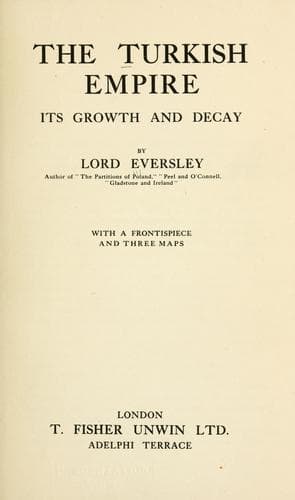
The Turkish Empire, Its Growth and DecayEversley, G. Shaw-Lefevre (George Shaw-Lefevre), Baron
History
The Turkish Empire, Its Growth and Decay
Eversley, G. Shaw-Lefevre (George Shaw-Lefevre), Baron
Turkey -- History
The great Turkish fleet had sailed from the Bosphorus on July 6th amid
many popular demonstrations. It was under the command of the Capitan
Pasha, Achmet, who proved to be a traitor. After passing through the
Dardanelles, instead of following his instructions by making his
course to the coast of Syria, Achmet sailed direct to Egypt, and there
entered the port of Alexandria with flying colours and handed over the
fleet to the enemy of the Sultan, the rebellious Pasha Mehemet Ali, a
proceeding without precedent in history. It was only accomplished, we
may presume, by profuse bribery on the part of the crafty Pasha.
Mahmoud was spared the knowledge of these two signal disasters to his
Empire. He died on July 1, 1839, some writers allege from the effect
of alcohol, though this is doubtful. Creasy and many other historians
are unstinting in praise of Mahmoud. They assign to him a very high
position in the list of Sultans. They bear testimony to his high
civic courage, and to the firm resolution with which he confronted
the many crises of his reign. We must fully admit these qualities.
Few sovereigns in history have had to deal with such a succession of
grave difficulties. Almost alone he bore the weight of Empire. We
must not, however, lose sight of the fact that his administration
and diplomacy were fraught with failure, that his Empire incurred
greater losses than under any previous Sultan, that his armies met
with invariable defeat, not only on the part of numerically weaker
armies of Russia, but also from insurgent Greeks and Serbians, and
even from Egyptians, whose fighting qualities were much inferior to
those of the Turks. His firmness and resolution were very great,
but they failed him at the supreme crisis of his career, when the
Russian army, with quite inadequate numbers, after serious losses in
battle and by disease, threatened Constantinople from Adrianople, and
when it is now quite certain that, if Mahmoud had stood firm and had
refused to come to terms, overwhelming disaster must have befallen the
Russians. At another crisis also his firmness amounted to most unwise
obstinacy when he refused, in 1827, to concede autonomy to Greece at
the instance of the Great Powers—a supreme error from which all his
subsequent misfortunes logically followed. Mahmoud seems also to have
been wanting in magnetism to inspire his generals and soldiers with his
own courage and resolution. He does not compare in this respect with
his contemporary and rival, Mehemet Ali. He had little of the martial
vigour and of the craft of that great vassal. If the Great Powers had
not intervened, it was highly probable, if not certain, that Ibrahim’s
army would, either in 1833 or in 1839, have marched to Constantinople,
have effected a revolution there, and have put an end to the Othman
dynasty. It might have given new life to the decadent Turkish Empire.
In any case, there was no reason why Mahmoud, if he had been endowed
Public-domain text, read in full here on John Shaqi.
Reviews
Reviews
No reviews yet
Be the first to share your thoughts on this work.
Elsewhere in the archive
Join the Discussion
Join the discussion
Sign in to leave a comment or review.
Sign InorCreate an account