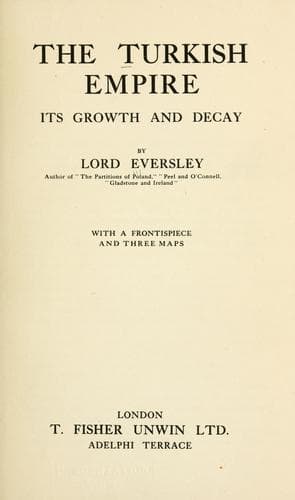
The Turkish Empire, Its Growth and DecayEversley, G. Shaw-Lefevre (George Shaw-Lefevre), Baron
History
The Turkish Empire, Its Growth and Decay
Eversley, G. Shaw-Lefevre (George Shaw-Lefevre), Baron
Turkey -- History
with Mehemet Ali’s genius and administrative capacity, should not
have created an army superior in force and discipline to that of the
Egyptian Pasha, and equal to the task of preventing the Russians from
crossing the Balkans.
XX
THE RULE OF ELCHIS
1839-76
MAHMOUD was succeeded by his son, Abdul Mehzid, a youth of sixteen
years, who proved to be of very different stamp from his father. He
was of mild and gentle nature, without physical or mental vigour,
and wanting in force of character. He was enfeebled early in his
reign by excessive indulgence in his harem. Later he was addicted to
alcohol, like many of his predecessors. His father had monopolized
power, and had frequently changed his ministers, with the result that
he left no statesman behind him who could impose his will on the
young Sultan and govern in his name. Nor was any lady of the harem
ambitious and competent to guide or misguide the ship of State, as had
not infrequently been the case in the past, when the reigning Sultan
was unequal to the task. The main power during this reign as regards
foreign affairs, and to some extent even as regards internal affairs,
seems to have been vested in the ambassadors of the Great Powers.
This power was exercised collectively by them on the rare occasions
when they were unanimously agreed, but at other times by one or other
of them, and chiefly, as will be seen, by the British Ambassador,
Sir Stratford Canning, later Lord Stratford de Redcliffe, who, by
his force of character and commanding presence, obtained immense
personal influence over the feeble mind of Abdul Mehzid, and exercised
an almost undisputed sway from 1842 to 1858, with the exception of
brief intervals when he was in England on leave, and when the Russian
Ambassador succeeded in obtaining exclusive influence.
The new Sultan was fortunate, as compared with his father, that in the
thirty-one years of his reign his Empire experienced no serious loss of
territory. It is necessary, however, to advert to the two main events
of it—the one, the suppression of Mehemet Ali’s ambitious projects and
the restriction of his hereditary Pashalic to Egypt; the other, the
Crimean War, as it is known in history—the war with Russia, the effect
of which was to stave off for nearly twenty years the dismemberment of
the Turkish Empire in Europe.
Public-domain text, read in full here on John Shaqi.
Reviews
Reviews
No reviews yet
Be the first to share your thoughts on this work.
Elsewhere in the archive
Join the Discussion
Join the discussion
Sign in to leave a comment or review.
Sign InorCreate an account