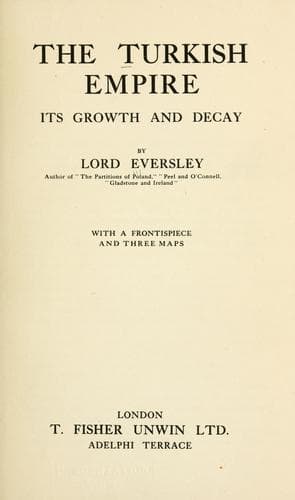
The Turkish Empire, Its Growth and DecayEversley, G. Shaw-Lefevre (George Shaw-Lefevre), Baron
History
The Turkish Empire, Its Growth and Decay
Eversley, G. Shaw-Lefevre (George Shaw-Lefevre), Baron
Turkey -- History
The conduct of the Emperor Nicholas on this occasion was most
conciliatory to the other Powers. He intimated to them that, if they
were united on a scheme to settle the Egyptian question, he would
not insist on the special right which he had acquired under the
treaties of Bucharest and of Akermann to exclude the ships of war of
other Powers from the Dardanelles, and that he would withdraw his
few remaining troops from Constantinople and the Bosphorus. Lord
Palmerston, on behalf of Great Britain, expressed his admiration of
this attitude of the Russian Emperor. As a result, a conference took
place in London between the representatives of the Great Powers, at
which Lord Palmerston, on behalf of England, and Baron Brunnow, on
behalf of Russia, took the leading part. Grave difference soon arose at
the conference on the part of France. Its Government, though strongly
opposed to Russia obtaining possession of Constantinople, had always
been favourable to the claim of Mehemet Ali to an hereditary Pashalic
in Egypt and Syria, and had secretly encouraged him to make himself
independent of the Porte. It now supported him against the veto of the
other Powers. Eventually England, Russia, and Austria, finding that
they could not come to agreement with France, decided to act without
its concurrence, and to compel Mehemet Ali to evacuate Syria and to
restore to the Porte the Turkish fleet. After long discussion between
these three Powers, a convention was agreed to on July 15, 1840. They
presented an ultimatum to Mehemet Ali, calling upon him to submit
himself to the Porte. They promised that if, within ten days of the
receipt of the ultimatum, he would give orders for the withdrawal of
his army from Syria, and would give up the Turkish fleet to the Porte,
he would be recognized as hereditary Pasha of Egypt and as Pasha of
Syria for his own life; but, if not, the offer of the life Pashalic
of Syria and the hereditary Pashalic of Egypt would be withdrawn, and
he would have to content himself with the Pashalic for life of Egypt.
It was also intimated to him that if there was refusal or delay the
fleets of the three Powers would at once institute a blockade of Egypt
and Syria. This ultimatum of the three Powers, when it became known in
France, caused the most profound indignation; the more so when, on the
refusal of Mehemet Ali to accede to the ultimatum, the British fleet,
supported by war vessels of the two other Powers, made its appearance
on the coast of Syria. This was thought to be an insult to France.
War between that country and England was imminent. There were violent
scenes in the French Chambers, and most bitterly hostile articles
in the French papers. There were threats of war on the part of the
Government of France. But prudent counsels ultimately prevailed, when
it was discovered that France was not prepared for a naval war, and
that its fleet could not hope to contend with the British fleet in the
Mediterranean or to land an army in Syria.
Public-domain text, read in full here on John Shaqi.
Reviews
Reviews
No reviews yet
Be the first to share your thoughts on this work.
Elsewhere in the archive
Join the Discussion
Join the discussion
Sign in to leave a comment or review.
Sign InorCreate an account