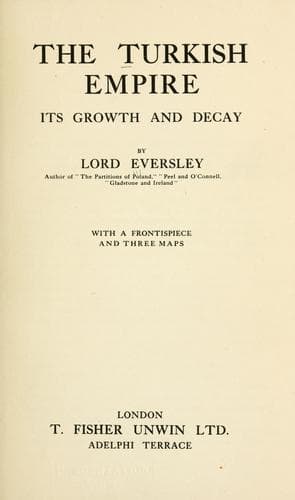
The Turkish Empire, Its Growth and DecayEversley, G. Shaw-Lefevre (George Shaw-Lefevre), Baron
History
The Turkish Empire, Its Growth and Decay
Eversley, G. Shaw-Lefevre (George Shaw-Lefevre), Baron
Turkey -- History
The three Powers, on their part, mainly at the instance of Lord
Palmerston, declined to submit their policy to the threats of France,
and persisted in their demonstration of force against Mehemet Ali. War
was averted between England and France, and Louis Philippe (then King
of the French) contented himself with the cynical observation that
there was all the difference in the world between threatening war and
actually going to war.
Meanwhile the British fleet, under Admirals Stopford and Napier,
appeared before Beyrout and bombarded and destroyed its forts. Two
thousand men were landed, under Napier, and defeated the Egyptian
forces. The same operation was repeated a few days later at Acre. The
powerful defences of this fortress were demolished by the guns of the
British fleet, and six thousand men were landed, under Napier, and
defeated Ibrahim’s army. It was in these attacks on Beyrout and Acre
that steamships made their first appearance in maritime war. The allies
were greatly assisted by the revolt of the people of Syria against
Mehemet Ali’s oppressive government. Desertion also was very rife in
the Egyptian force, and Ibrahim’s army, which had originally consisted
of seventy-five thousand men, had dwindled down to twenty-five thousand.
After these operations on the coast of Syria, Napier and his squadron
appeared before Alexandria and threatened bombardment. But Mehemet
Ali, by this time, had realized that he could not hope to make war
successfully against the three Great Powers as well as the Sultan. He
entered into negotiations with Admiral Napier. He agreed to evacuate
Syria and to give up the Turkish fleet to the Porte, provided that
the Sultan would recognize him as hereditary Pasha of Egypt. In the
meantime the Sultan of Turkey had issued a firman deposing Mehemet Ali
from all his Pashalics. This did not necessarily mean much, for the
Porte on four previous occasions had publicly deposed the rebellious
pasha, but without any result. Eventually, on September 20, 1841,
agreement was arrived at between Mehemet Ali and the three Powers. In
spite of his deposition by the Sultan, Mehemet Ali was confirmed in
the position of hereditary Pasha of Egypt, but was deprived of all
his other governments. He was to pay tribute to the Porte equal to
one-fourth of the revenue of Egypt—later fixed at an annual sum of
£400,000. He was to withdraw his army from Syria and to maintain no
larger force in Egypt than eighteen thousand men.
Public-domain text, read in full here on John Shaqi.
Reviews
Reviews
No reviews yet
Be the first to share your thoughts on this work.
Elsewhere in the archive
Join the Discussion
Join the discussion
Sign in to leave a comment or review.
Sign InorCreate an account