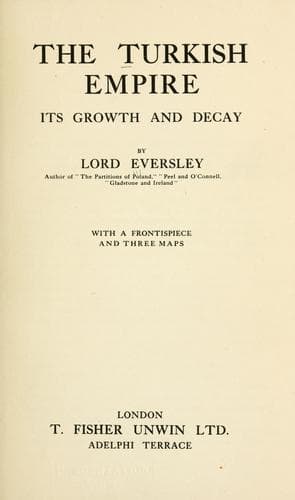
The Turkish Empire, Its Growth and DecayEversley, G. Shaw-Lefevre (George Shaw-Lefevre), Baron
History
The Turkish Empire, Its Growth and Decay
Eversley, G. Shaw-Lefevre (George Shaw-Lefevre), Baron
Turkey -- History
Later he had been engaged in the delimitation of Greece, after the
recognition of its independence, and had shown himself a Philhellene.
In 1842 Lord Aberdeen, then Foreign Minister of England, sent him again
as ambassador to the Porte at the age of fifty-seven. He remained
there, with two short intervals, till 1858. He acquired, during these
sixteen years, the title of “The Great Elchi,” the ambassador _par
éminence_. By the Christian rayas of the Ottoman Empire he was known
as the Padishah of the Padishahs. He was the most distinguished envoy
ever employed in the British Diplomatic Service. He belonged to an old
school of diplomats, when communications with the Home Government were
long in reaching their destination, and when ambassadors necessarily
took much responsibility upon themselves, and dictated rather than
followed the policy of their Governments. He held himself to represent
his sovereign rather than the transient ministers of the day. His
mien was such as greatly to impress the Turks. It was stately and
dignified. His countenance was noble and spirituelle. His eyes seemed
to penetrate the minds of those with whom he transacted business,
and made it difficult for them to conceal their intentions. His own
methods were always honourable and straightforward. Though he was well
versed in the arts of diplomacy and could meet mine by countermine,
he never resorted to trickery. The Turks learned that his word was
implicitly to be trusted, and that he wished well to their country.
He treated the Turkish ministers with the utmost hauteur. With some
of them, whose hands were known to be stained with blood, he refused
to have any communication. If his demands were refused at the Porte,
he went direct to the Sultan and fairly bullied that weak, gentle,
and well-intentioned sovereign into acquiescence. He entered on his
work in this embassy with two main convictions, one might almost say
obsessions—the one that it was the interest of England, and therefore
his own duty, to oppose the schemes of Russia at every turn; the other
that it was his duty to urge, and even to compel, the Porte to carry
out internal reforms, and to come into line with other civilized
countries in Europe, in default of which he fully recognized that the
Ottoman Empire could not be maintained. He had a firm belief that this
was possible, and that he was himself the appointed man to effect it.
For this purpose he freely made use of threats of force from England if
his behests were refused, and of promises of protection against Russia
if they were agreed to. An envoy of this character, great as were his
qualities and personal merits, was a cause of embarrassment to British
policy, for the Government could not control him. One might say of him,
in the words of Shakespeare:—
If great men could thunder as Jove himself does,
Jove would ne’er be quiet.
Public-domain text, read in full here on John Shaqi.
Reviews
Reviews
No reviews yet
Be the first to share your thoughts on this work.
Elsewhere in the archive
Join the Discussion
Join the discussion
Sign in to leave a comment or review.
Sign InorCreate an account