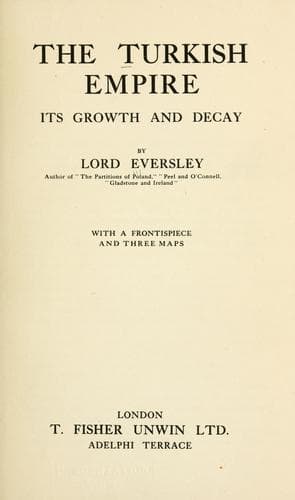
The Turkish Empire, Its Growth and DecayEversley, G. Shaw-Lefevre (George Shaw-Lefevre), Baron
History
The Turkish Empire, Its Growth and Decay
Eversley, G. Shaw-Lefevre (George Shaw-Lefevre), Baron
Turkey -- History
The intervention of the three Great Powers, taking the matter out
of the hands of the Sultan, brought about an arrangement much more
favourable to him than the Divan were willing to agree to. Syria
was relieved of the government of Mehemet Ali and was placed again
under the control of the Porte. Egypt, on the other hand, was made
practically independent, subject only to a fixed tribute in recognition
of the nominal suzerainty of the Sultan. This result was achieved
not by the force of arms of the Sultan, but by the action of the
three Great Powers, directed chiefly by the able diplomacy of Lord
Palmerston, who steered this concert through all its difficulties and
against the violent opposition of France. The final settlement thus
imposed on Mehemet Ali, which extinguished his ambitious projects and
reduced his rule to Egypt alone, is said to have broken the heart of
the old man. He lived on for eight more years, but they were spent
in gloom and depression, aggravated by the death of his able and
distinguished son Ibrahim. It should be added here that in 1841, as
a sequel to the arrangement about Egypt, a convention was agreed to
between the Great Powers, including Russia, and Turkey by which the
vessels of war of all countries except Turkey were forbidden to pass
through the Straits to and from the Black Sea.
The settlement of these grave questions, in 1841, was followed by
twelve years of comparative repose in Turkey, broken only by occasional
revolts of pashas, or of subject races driven to desperation by chronic
misgovernment. These were put down by the Seraskier, Omar Pasha, who
proved to be a very competent general for this purpose. It was during
this period that Sir Stratford Canning, as British Ambassador to the
Porte, attained a personal influence over the Sultan, Abdul Mehzid, of
an unprecedented character, such that he may be said to have virtually
ruled the State.
Canning on three previous occasions had represented the British
Government at Constantinople during the reign of Mahmoud. In 1812 as
Minister Plenipotentiary, when quite a young man, he had gained immense
credit by inducing the Sultan to come to terms with Russia, by the
treaty of Bucharest. The effect of this was to free the hands of the
Czar and to enable him to withdraw his army from the Danube and to use
it on the flank of Napoleon’s army in the celebrated Moscow campaign.
This largely contributed to the defeat of the invasion of Russia.
Public-domain text, read in full here on John Shaqi.
Reviews
Reviews
No reviews yet
Be the first to share your thoughts on this work.
Elsewhere in the archive
Join the Discussion
Join the discussion
Sign in to leave a comment or review.
Sign InorCreate an account