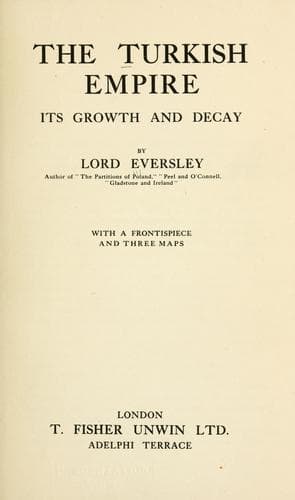
The Turkish Empire, Its Growth and DecayEversley, G. Shaw-Lefevre (George Shaw-Lefevre), Baron
History
The Turkish Empire, Its Growth and Decay
Eversley, G. Shaw-Lefevre (George Shaw-Lefevre), Baron
Turkey -- History
In answer to these overtures the British Government, through Lord John
Russell, the Foreign Secretary, disclaimed all intention of aiming at
the acquisition either of Constantinople or any other of the Sultan’s
possessions, and accepted the assurances of the like effect which were
given by the Czar. It combated the opinion that the extinction of the
Ottoman Empire was near at hand and deprecated a discussion based
on this supposition as leading directly to produce the very result
against which it was hoped to provide. Finally, the British Government,
with abundance of courtesy, but in terms very stringent and clear,
peremptorily refused to enter into any kind of secret engagement with
Russia for the settlement of the Eastern question.
Lord Clarendon, who succeeded Lord John Russell as Foreign Minister in
the course of these proceedings, in a final despatch to Sir Hamilton
Seymour (March 23, 1853), expressed the following opinion:—
Turkey only requires forbearance on the part of its allies, and a
determination not to press their claims in a manner humiliating to
the dignity and independence of the Sultan—that friendly support,
in short, which among States as well as individuals the weak are
entitled to expect from the strong—in order not only to prolong
its existence but to remove all cause for alarm respecting its
dissolution.
It will be seen that the British Government took much too sanguine a
view of the prospects of reformed Government in Turkey, and that the
Emperor of Russia was much nearer the mark.
We have quoted these conversations at length because of their extreme
importance when read by the light of subsequent events. They produced a
bad impression at the time on the British Government, and still more so
on public opinion in England, when later they were made public.[35] It
was thought that they indicated a deliberate intention on the part of
the Emperor of Russia to force the Eastern question to the front, and
to dismember the Ottoman Empire by a partition of the same kind as that
to which Poland had been treated, a few years back, and in which Russia
would have the lion’s share.
A more reasonable view may now be taken of the policy of the Emperor
Nicholas. Subsequent events have conclusively shown that he was fully
justified in describing the Turkish Empire as sick, almost to death,
for since then it has lost almost the whole of its dominions in Europe.
Russia also has acquired but a very small share of the vast territories
that have been taken from it. It is also subject to the reflection
that, although the British Government in 1852 disclaimed any wish or
intention to join in a scheme of partition of the Ottoman Empire, it
has since acquired a considerable part of it, approximating to the
offer of the Czar—namely Egypt, the Sudan, and the island of Cyprus.
Public-domain text, read in full here on John Shaqi.
Reviews
Reviews
No reviews yet
Be the first to share your thoughts on this work.
Elsewhere in the archive
Join the Discussion
Join the discussion
Sign in to leave a comment or review.
Sign InorCreate an account