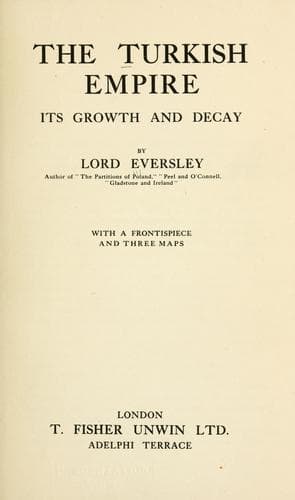
The Turkish Empire, Its Growth and DecayEversley, G. Shaw-Lefevre (George Shaw-Lefevre), Baron
History
The Turkish Empire, Its Growth and Decay
Eversley, G. Shaw-Lefevre (George Shaw-Lefevre), Baron
Turkey -- History
By Stratford’s advice the Porte determined to resist the Russian
demands. The claim to protect the members of the Greek Church was
pronounced to be inadmissible. Prince Menschikof was informed to this
effect, and on May 21st he broke off diplomatic relations with the
Porte, and left Constantinople in high dudgeon. This was followed,
on May 31st, by an arrogant despatch to the Porte from the Russian
Government, insisting on the acceptance of the Menschikof demands.
At the instance of Stratford, the Porte again refused, and thereupon
a Russian army crossed the Pruth, on July 3rd, and occupied Moldavia
and Wallachia. In a manifesto, issued a few days later, the Czar
disclaimed any intention of conquest, and justified his occupation of
the provinces as a material guarantee for the fulfilment of his demands
on behalf of the Christian population of Turkey.
That there was ample cause for the complaints of the Russian Government
of the maltreatment of the Christian population in Turkey cannot
be disputed. On July 22, 1853, Lord Stratford himself, in a formal
communication to the Porte, forwarded reports from the British Consuls
at Scutari, Monastir, and Prevesa, which detailed “acts of disorder,
injustice, and corruption of a very atrocious kind, which he had
frequently brought to the notice of the Ottoman Porte.” He complained
that the assurances given by the late Grand Vizier of remedies for
such evils had not been carried out, and he observed, with extreme
disappointment and pain, the continuance of evils which affected so
deeply the welfare of the Empire.
Again, on July 4th of the same year, in a further communication to the
Porte, Lord Stratford wrote:—
The character of disorderly and brutal outrages may be said with
truth to be in general that of Mussulman fanaticism, excited by
cupidity and hatred against the Sultan’s Christian vassals.
Unless some powerful means be applied without further delay, it
is to be feared that the authority of the central Government will
be completely overpowered and that the people, despairing of
protection, will augment the disorder by resorting to lawless means
of self-preservation.
Lord Clarendon, the Foreign Minister, also, in a communication to the
British Ambassador, showed that he was fully alive to the serious
character of the disorders in the Turkish Empire. He wrote:—
Public-domain text, read in full here on John Shaqi.
Reviews
Reviews
No reviews yet
Be the first to share your thoughts on this work.
Elsewhere in the archive
Join the Discussion
Join the discussion
Sign in to leave a comment or review.
Sign InorCreate an account