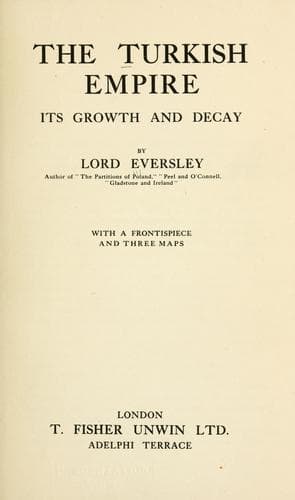
The Turkish Empire, Its Growth and DecayEversley, G. Shaw-Lefevre (George Shaw-Lefevre), Baron
History
The Turkish Empire, Its Growth and Decay
Eversley, G. Shaw-Lefevre (George Shaw-Lefevre), Baron
Turkey -- History
It is impossible to suppose that any true sympathy for their rulers
will be felt by the Christian subjects of the Porte, so long as
they are made to experience in all their daily transactions the
inferiority of their position as compared with that of their
Mussulman fellow-subjects; so long as they are aware that they will
seek in vain for justice for wrongs done either to their persons
or their properties, because they are deemed a degraded race,
unworthy to be put into comparison with the followers of Mahomet.
Your Excellency will plainly and authoritatively state to the Porte
that this state of things cannot be longer tolerated by Christian
Powers. The Porte must decide between the maintenance of an erroneous
principle and the loss of sympathy and support of its allies.
In spite, however, of the experience of the futility of all past
promises to carry out the most elementary reforms in favour of the
Christian subjects of the Porte, both Lord Stratford and Lord Clarendon
appear to have based their policy largely on the belief that the Porte
would be more amenable in the future.
The occupation of the Danubian principalities by a Russian army did not
of itself necessarily involve war with Turkey. Though the Sultan was
suzerain of these provinces, they enjoyed complete autonomy under the
protection of Russia. Under certain conditions that Power was entitled
to send its army there. But the continued occupation of them was
clearly antagonistic to the sovereign rights of the Sultan and would
ultimately lead to war.
With a view to avoid war, a conference was held by the representatives
of all the Powers except Russia at Vienna, and an agreement was arrived
at for the settlement of the question between Russia and Turkey by
England, France, Austria, and Prussia. This was agreed to by Russia.
It was commended to the Porte by the Powers, and Lord Stratford was
instructed by Lord Clarendon to use all his efforts to obtain its
consent.
Officially, Lord Stratford performed his task in due accord with
the instructions of Lord Clarendon. But his biographer and, still
more, Mr. Kinglake admit that the rejection of the Vienna demand was
mainly due to the British Ambassador. After quoting the words of Lord
Stratford, in which he described his efforts to induce the Porte to
accede to it, Kinglake writes:—
Public-domain text, read in full here on John Shaqi.
Reviews
Reviews
No reviews yet
Be the first to share your thoughts on this work.
Elsewhere in the archive
Join the Discussion
Join the discussion
Sign in to leave a comment or review.
Sign InorCreate an account