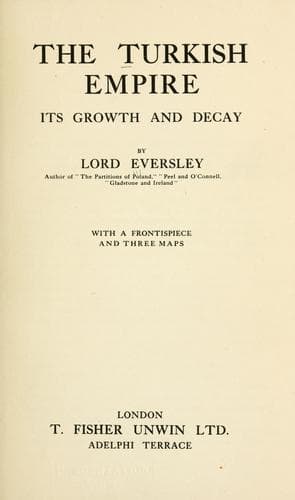
The Turkish Empire, Its Growth and DecayEversley, G. Shaw-Lefevre (George Shaw-Lefevre), Baron
History
The Turkish Empire, Its Growth and Decay
Eversley, G. Shaw-Lefevre (George Shaw-Lefevre), Baron
Turkey -- History
Another event also occurred in 1870, the significance of which was not
fully appreciated at the time. Previous to that year the Christian
Slav populations of the Balkans, such as the Bulgarians, Bosnians, and
others, were under the spiritual jurisdiction of the Greek Ecumenical
Patriarch and were regarded as Greeks. The ancient history of Bulgaria
and its claims to a distinct nationality appear to have been forgotten
or ignored by politicians interested in the Eastern question. On
March 10, 1870, Abdul Aziz, under pressure from Russia, backed by its
able ambassador, General Ignatief, issued a firman recognizing the
separate existence of Bulgaria, and creating for it a national Church
independent of the Greek Church, though differing in no important
respect in point of doctrine or ritual. This laid the foundation for
a new nationality in the Balkans. Bulgaria, long forgotten, emerged
from obscurity and came to the front as a competitor of the Greeks.
The importance of this will be appreciated later, when we come to the
rivalry of these races for the débris of the Ottoman Empire in Europe.
In 1876 a bloodless revolution took place in Constantinople. A new
ministry was forced upon Abdul Aziz, of which Midhat Pasha—one of
the few genuine and convinced reformers among the leading Turks—was
a member. They decided to depose the Sultan. They obtained a _fetva_
from the Mufti justifying this on the ground of his incapacity and
extravagance. No single hand was raised in his favour. After a vain
protest, he submitted to his fate, and was removed from his palace to
another building destined to be his prison. Four days later he was
found dead there, and nineteen physicians of the city, including men of
all nationalities, testified that Abdul Aziz died by his own hand.
XXI
ABDUL HAMID II
1876-1909
ON the deposition of Abdul Aziz, his nephew, the eldest son of Abdul
Mehzid, much against his will, was proclaimed as Sultan, under the
title of Murad V. His feeble mind, reduced to a nullity by long
seclusion in the Cage, and by the habit of intemperance, was completely
unhinged by this unexpected elevation, and after a few weeks—on August
31, 1876—it became necessary for the committee of ministers who had
set him on the throne to depose him in favour of the next heir. His
brother, Abdul Hamid II, held the Sultanate for thirty-three years, and
is still alive, in the custody of another brother, the present Sultan,
after being deposed, in his turn, in 1909.
Public-domain text, read in full here on John Shaqi.
Reviews
Reviews
No reviews yet
Be the first to share your thoughts on this work.
Elsewhere in the archive
Join the Discussion
Join the discussion
Sign in to leave a comment or review.
Sign InorCreate an account