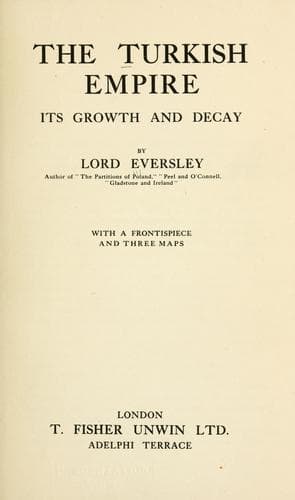
The Turkish Empire, Its Growth and DecayEversley, G. Shaw-Lefevre (George Shaw-Lefevre), Baron
History
The Turkish Empire, Its Growth and Decay
Eversley, G. Shaw-Lefevre (George Shaw-Lefevre), Baron
Turkey -- History
Abdul Hamid proved to be the most mean, cunning, untrustworthy, and
cruel intriguer of the long dynasty of Othman. His mother was an
Armenian. He was destitute of physical courage. He lived in constant
fear of plots and assassination, and in suspicion of every one about
him. He trusted no one, least of all his ministers. He allowed no
consultations between them. If he heard that two of them had met in
private, his suspicions were aroused and they were called to account.
He employed a huge army of spies, who reported to him directly and
daily as to the doings of his ministers, of the ambassadors, and of
any one else of importance. They fed him with reports, often false,
on which he founded his actions. Plots were invented in order to
induce him to consent to measures which otherwise he would not have
sanctioned. He claimed and exercised the right of secret assassination
of his foes or suspected foes. No natives of Turkey were safe. They
might disappear at any moment, as so many thousands had done by the
order of the Sultan, through some secret agent, either to death or
exile. This was not so much from pure wickedness of heart as from fear
of being assassinated himself, and the belief that his safety lay in
exterminating his enemies before they had the chance of maturing their
plans against himself. The ambassadors of foreign Powers had little
influence with him, except so far as they were able to threaten the
use of armed force, when, sooner than risk war, he gave way. He showed
great cunning in playing off one ambassador against another, and was an
adept in all the meanest intrigues of diplomacy.
Abdul Hamid’s life was one of incessant labour. He devoted himself most
assiduously to the work of his great office. Whatever his demerits,
he was absolute master of his ministers and of his State. There never
was a more centralized and meticulous despotism. As he trusted no one,
he was overwhelmed by most trivial details and graver questions were
neglected. He could not, indeed, administer the vast affairs of his
Empire without information or advice from others, but no one knew from
day to day who was the person on whose advice the Sultan overruled
his ostensible ministers, whether a favourite lady of his harem, or a
eunuch, or some fanatical dervish, or an astrologer, or a spy. There
was constant confusion in the State, arising from antagonism between
the officials of the Porte and the minions of the palace.
Public-domain text, read in full here on John Shaqi.
Reviews
Reviews
No reviews yet
Be the first to share your thoughts on this work.
Elsewhere in the archive
Join the Discussion
Join the discussion
Sign in to leave a comment or review.
Sign InorCreate an account