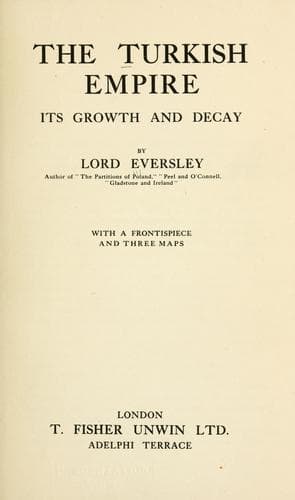
The Turkish Empire, Its Growth and DecayEversley, G. Shaw-Lefevre (George Shaw-Lefevre), Baron
History
The Turkish Empire, Its Growth and Decay
Eversley, G. Shaw-Lefevre (George Shaw-Lefevre), Baron
Turkey -- History
The bad harvest of 1874 was the immediate cause of the outbreak, for
the farmers of the taxes refused to make any concessions. It was, in
the first instance, directed rather against the Moslem landowners
and the local Turkish officials than against the Sultan, but it
rapidly developed into a general insurrection against the Sultan’s
government. Every effort was made by Austria and Russia to localize
it and to induce the Porte to make concessions. Count Andrassy,
the Austro-Hungarian Foreign Minister, drew up a scheme for the
pacification of the two provinces. It proposed that the system of
farming the taxes should be abolished, that the taxes raised in the
provinces should be expended locally for their benefit, that complete
religious equality should be established, and that a mixed commission
should be appointed to supervise the carrying out of these reforms. The
scheme was agreed to by Russia, Great Britain, and the other Powers,
and was presented to the Sultan, who acquiesced in it. But it proved,
like other promises of reform in Turkey, to be a dead letter. Not a
single step was taken to give effect to any part of it. The rebellion
in the two provinces continued. The insurgents increased their demands.
They insisted that one-third of the land should be given up to the
rayas. The movement soon extended to Bulgaria, which was seething with
disaffection.
On April 21, 1876, an outbreak of Bulgarians occurred on the southern
slopes of the Rhodope Mountains, of which Batak was the centre. It
was put down without difficulty by a small Turkish force sent from
Constantinople, under Achmet Agha, with little loss of life to the
troops engaged, but with relentless cruelty, not only to the actual
insurgents who surrendered on promise of life, but to the whole
population of the district. Bands of Bashi-Bazouks, consisting of
Tartars from the Crimea who had been planted in Bulgaria, were let
loose on them. Indiscriminate murders, rapes, and rapine took place.
Sixty villages were burnt. Twelve hundred persons, mostly women and
children, took refuge in a church at Batak and were there burnt
alive. In all about twelve thousand persons perished in these brutal
reprisals. Achmet Agha received a high decoration from the Sultan for
this performance. There was nothing new in this method of dealing with
an outbreak by the Porte. It was in accord with its traditional system
and policy to wreak vengeance on those revolting by orgies of cruelty,
which would strike terror among subject races and act as a warning to
them in the future.
Public-domain text, read in full here on John Shaqi.
Reviews
Reviews
No reviews yet
Be the first to share your thoughts on this work.
Elsewhere in the archive
Join the Discussion
Join the discussion
Sign in to leave a comment or review.
Sign InorCreate an account