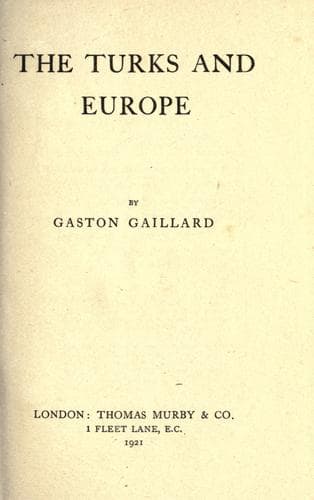
Treaty of Sèvres (1920); World War, 1914-1918 -- Territorial questions -- Turkey; World War, 1914-1918 -- Turkey
After a long interview with the Sultan, which lasted two hours, on
June 11, the Grand Vizier Damad Ferid Pasha, owing to the difficulty
of communicating between Paris and Constantinople, and the necessity
of co-ordinating the draft of the answer worked out by the Ottoman
Government and the reports drawn up by the various commissions with the
answer recommended by the delegation, set off to Paris the next day. So
it seemed likely that Turkey would ask for further time before giving
her answer.
It could already be foreseen that in her answer Turkey would protest
against the clauses of the treaty concerning Thrace and Smyrna,
against the blow struck at the sovereignty of the Sultan by the
internationalisation of the Bosphorus and the Dardanelles, as thus the
Sultan could no longer leave his capital and go freely to Asia Minor,
and, lastly, against the clauses restoring the privileges of the
Capitulations to the States that enjoyed them before the war.
Turkey also intended to ask that the Sultan should keep his religious
rights as Caliph over the Mussulmans detached from the Empire, and that
a clause should be embodied in the treaty maintaining the guarantee
in regard to the interior loan raised during the war, for otherwise
a great many subscribers would be ruined and the organisation of the
property of the orphans would be jeopardised.
At the beginning of the second week of June it was rumoured that the
treaty might be substantially amended in favour of Turkey.[30] Perhaps
Great Britain, seeing how things stood in the East, and that her policy
in Asia Minor raised serious difficulties, felt it necessary to alter
her attitude with regard to Turkish Nationalism which, supported by
the Bolshevists, was getting more and more dangerous in Persia. For
Mr. Lloyd George, who has always allowed himself to be led by the
trend of events, and whose policy had lately been strongly influenced
by the Bolshevists, had now altered his mind, as he often does, and
seemed now inclined, owing to the failure of his advances to the Soviet
Government, to modify his attitude towards Constantinople—after having
exasperated Turkish Nationalism. The debate that was to take place on
June 15 in the House of Lords as to what charges and responsibilities
England had assumed in Mesopotamia, was postponed—which meant much; and
the difficulties just met with by the British in the Upper Valley of
the Tigris and the Euphrates in their struggle with the Arabs convinced
them of the advisability of a revision of the British policy towards
both the Arabs and the Turks.
Public-domain text, read in full here on John Shaqi.
Reviews
Reviews
No reviews yet
Be the first to share your thoughts on this work.
Elsewhere in the archive
Join the Discussion
Join the discussion
Sign in to leave a comment or review.
Sign InorCreate an account