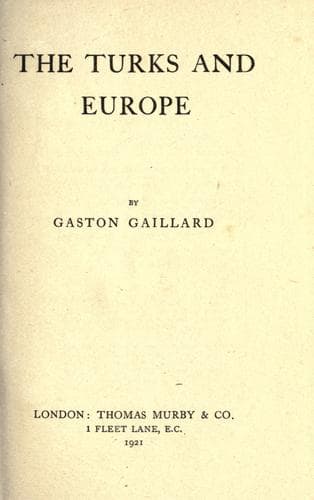
Treaty of Sèvres (1920); World War, 1914-1918 -- Territorial questions -- Turkey; World War, 1914-1918 -- Turkey
Henceforth it was obvious that the chief stipulations of the treaty
that was to be enforced on Turkey were doomed to failure, and it was
asked with no little anxiety whether the Powers would be wise enough
to take facts into account and reconsider their decisions accordingly,
or maintain them and thus pave the way to numerous conflicts and
fresh difficulties. Indeed, the outcome of the arrangements they had
laboriously elaborated was that things in the East had become more
intricate and critical than before. No State wished to assume the
task of organising the Armenian State: the American Senate flatly
refused; Mr. Bonar Law formally declared in the House of Commons that
England had already too many responsibilities; France did not see
why she should take charge of it; Italy accepted no mandate in Asia
Minor. Syria, on the other hand, protested against its dismemberment.
Mesopotamia was rising against the English at the very time when the
Ottoman Nationalists entered an indignant protest against the cession
of Smyrna and Thrace to Greece.
It was to be wished, therefore, from every point of view that not only
some articles of the treaty presented to the Turks, but the whole
document, should be remodelled, and more regard should be paid to the
lawful rights of the Ottoman Empire, a change which could only serve
French interests.
But though reason and her interest urged France to maintain the Ottoman
Empire—which she attempted to do to some extent—she allowed herself
to be driven in a contrary direction by England, who thought she
could take advantage of the perturbation caused by the war within the
Turkish Empire to dismember it—not realising that this undertaking
went against her own Asiatic interests, which were already seriously
endangered. Such a submission to the English policy was all the more
to be regretted as Mr. Lloyd George had but grudgingly supported
the French policy with regard to Germany, and after the San Remo
conversations it seemed that France would have to consent to heavy
sacrifices in the East in return for the semi-approbation he had
finally granted her. This policy of England well might surprise the
French—who have always reverenced the British parliamentary system;
for the so-styled imperialist policy of Queen Victoria or King Edward,
though it has been violently criticised, had really kept up the old
traditions of British Liberalism, and had nothing in common with the
greed and cool selfishness of such demagogues and would-be advanced
minds as Mr. Lloyd George, who stands forth before the masses as the
enemy of every imperialism and the champion of the freedom of peoples.
But the former leaders of English foreign policy were not constantly
influenced by their own political interests; they knew something of
men and countries; and they had long been thoroughly acquainted with
the ways of diplomacy. Both in England and France, everyone should now
acknowledge their fair-mindedness, and pay homage alike to their wisdom
Public-domain text, read in full here on John Shaqi.
Reviews
Reviews
No reviews yet
Be the first to share your thoughts on this work.
Elsewhere in the archive
Join the Discussion
Join the discussion
Sign in to leave a comment or review.
Sign InorCreate an account