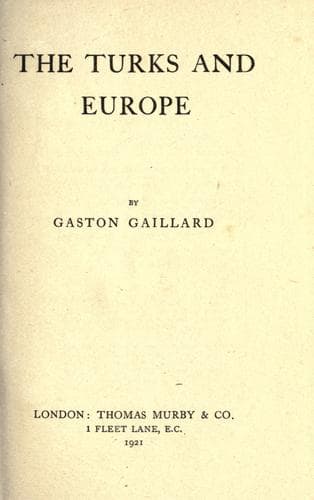
Treaty of Sèvres (1920); World War, 1914-1918 -- Territorial questions -- Turkey; World War, 1914-1918 -- Turkey
“The economic distress now prevailing in the Erivan area is due
to the enormous number of refugees coming from the neighbouring
Ottoman provinces who are encamped there temporarily. If these
territories were included in the Armenian State, the situation
would be much better, for all these refugees would be able to
return to their homes and till their lands. With a reasonable
foreign support, the surviving manhood of the nation would suffice
to establish a National State in this territory, which includes but
one-fourth of the total Armenian State to be detached from Turkey.
In the new State, the Armenians will still be more numerous than
the other non-Armenian elements, the latter not being connected
together and having been decimated during the war like the
Armenians.”
Finally, in support of its claim, the Committee urged that the
Nationalist movement of Mustafa Kemal was a danger to England, and
showed that only Armenia could check this danger.
“For if Mustafa Kemal’s Government is not overthrown, our new
Kurdish frontier will never be at peace; the difficulties of its
defence will keep on increasing; and the effect of the disturbances
will be felt as far as India. If, on the contrary, that focus of
disturbance is replaced by a stable Armenian State, our burden will
surely be alleviated.”
Then the British Armenia Committee, summing up its chief claims, asked
for the complete separation of the Ottoman Empire from the Armenian
area, and, in default of an American mandate, the union of the Armenian
provinces of the Turkish Empire contiguous to the Republic of Erivan
with the latter Republic, together with a port on the Black Sea.
In the report which had been drawn up by the American Commission of
Inquiry sent to Armenia, with General Harboor as chairman, and which
President Wilson had transmitted to the Senate at the beginning of
April, 1920, after the latter assembly had asked twice for it, no
definite conclusion was reached as to the point whether America was to
accept or refuse a mandate for that country. The report simply declared
that in no case should the United States accept a mandate without the
agreement of France and Great Britain and the formal approbation of
Germany and Russia. It merely set forth the reasons for and against the
mandate.
It first stated that whatever Power accepts the mandate must have
under its control the whole of Anatolia, Constantinople, and
Turkey-in-Europe, and have complete control over the foreign relations
and the revenue of the Ottoman Empire.
Public-domain text, read in full here on John Shaqi.
Reviews
Reviews
No reviews yet
Be the first to share your thoughts on this work.
Elsewhere in the archive
Join the Discussion
Join the discussion
Sign in to leave a comment or review.
Sign InorCreate an account