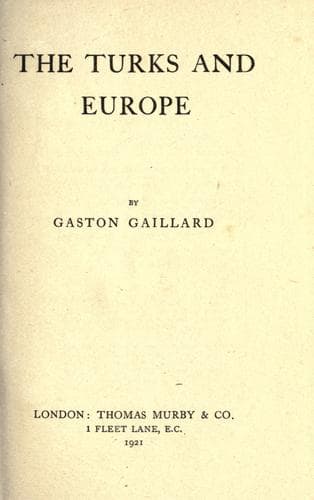
Treaty of Sèvres (1920); World War, 1914-1918 -- Territorial questions -- Turkey; World War, 1914-1918 -- Turkey
Under these circumstances the complete solution of the Armenian problem
was postponed indefinitely, and it is difficult to foresee how the
problem will ever be solved.
2. THE PAN-TURANIAN AND PAN-ARABIAN MOVEMENTS.
The attempts at Russification made immediately after the 1877 war
by means of the scholastic method of Elminski resulted in the first
manifestations of the Pan-Turanian movement. They arose, not in Russia,
but in Russian Tatary. The Tatars of the huge territories of Central
Asia, by reason of their annexation to the Russian Empire and the
indirect contact with the West that it entailed, and also owing to
their reaction against the West, awoke to a consciousness of their
individuality and strength.
A series of ethnographic studies which were begun at that time by M.
de Ujfalvi upon the Hungarians—all the peoples speaking a Finno-Ugrian
idiom descending from the same stock as those who speak the Turkish,
Mongol, and Manchu languages—and were continued by scholars of various
nationalities, gave the Pan-Turanian doctrine a scientific basis;
the principles of this doctrine were laid down by H. Vambéry,[40]
and it was summed up by Léon Cahun in his _Introduction a l’histoire
de l’Asie_.[41] This Turco-Tartar movement expanded, and its most
authoritative leaders were Youssouf Ahtchoura Oglou; Ahmed Agayeff,
who was arrested at the beginning of the armistice by the English as a
Unionist and sent to Malta; and later Zia Geuk Alp, a Turkish poet and
publicist, the author of _Kizil-Elma_ (The Red Apple), who turned the
Union and Progress Committee towards the Pan-Turanian movement though
he had many opponents on that committee, and who was arrested too and
sent to Malta.
Islam for thirteen centuries, by creating a religious solidarity
between peoples of alien races, had brought about a kind of religious
nationality under its hegemony. But the ambitious scheme of
Pan-Islamism was jeopardised in modern times by new influences and
widely different political aspirations. It was hoped for some time that
by grouping the national elements of Turkey and pursuing a conciliatory
policy it would be possible to give a sound basis to that religious
nationality. But that nationality soon proved unable to curb the
separatist aspirations of the various peoples subjected to the Turkish
yoke, and then, again, it wounded the pride of some Turkish elements
by compelling them to obey the commandments of Islam, to which all the
Turanian populations had not fully adhered. The Pan-Islamic movement
later on grew more and more nationalist in character, and assumed a
Pan-Turkish tendency, though it remained Pan-Turanian—that is to say,
it still included the populations speaking the Turkish, Mongol, and
Manchu languages.
Public-domain text, read in full here on John Shaqi.
Reviews
Reviews
No reviews yet
Be the first to share your thoughts on this work.
Elsewhere in the archive
Join the Discussion
Join the discussion
Sign in to leave a comment or review.
Sign InorCreate an account