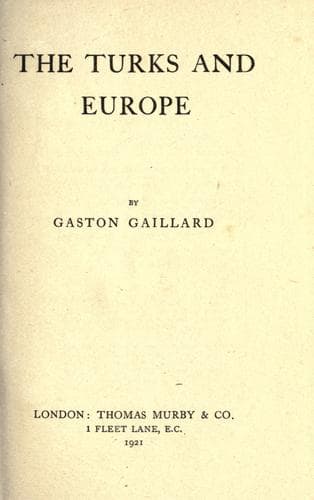
Treaty of Sèvres (1920); World War, 1914-1918 -- Territorial questions -- Turkey; World War, 1914-1918 -- Turkey
Without in any way giving up the Pan-Islamic idea, Turkish Nationalism
could not but support the Pan-Turanian movement, which it hoped would
add the 18 million Turks living in the former Russian Empire, Persia,
and Afghanistan, to the 8 million Turks of the territories of the
Ottoman Empire.
Owing to its origin and the character it has assumed, together with the
geographical situation and importance of the populations concerned,
this movement appears as a powerful obstacle to the policy which
England seems intent upon pursuing, and to which she seeks to bring
over Italy and France. It also exemplifies the latent antagonism which
had ever existed between the Arabian world and the Turkish world, and
which, under the pressure of events, soon asserted itself.
Indeed, the mutual relations of the Arabs and the Turks had been slowly
but deeply modified in the course of centuries.
After the great Islamic movement started by Mohammed in the seventh
century, the Arabs who had hitherto been mostly confined within the
boundaries of the Arabian peninsula spread to the west over the whole
of Northern Africa as far as Spain, and to the east over Mesopotamia
and a part of Persia. In the twelfth century Arabian culture reached
its climax, for the Arabian Caliphs of Baghdad ruled over huge
territories. At that time Arabic translations revealed to Europe the
works of Aristotle and of the Chaldean astronomers, and the Arabs,
through Spain, had an important influence on the first period of modern
civilisation.
In 1453, when the Turks, who had extended their dominion over all the
shores of the Mediterranean, settled at Constantinople, which became
the capital of the Islamic Empire, the influence of Arabia decreased;
yet the Arabs still enjoyed in various parts political independence and
a kind of religious predominance.
For instance, the Arabs settled in the north of Western Africa, after
losing Spain, became quite independent, and formed the Empire of
Morocco, which was not under the suzerainty of Constantinople.
Public-domain text, read in full here on John Shaqi.
Reviews
Reviews
No reviews yet
Be the first to share your thoughts on this work.
Elsewhere in the archive
Join the Discussion
Join the discussion
Sign in to leave a comment or review.
Sign InorCreate an account