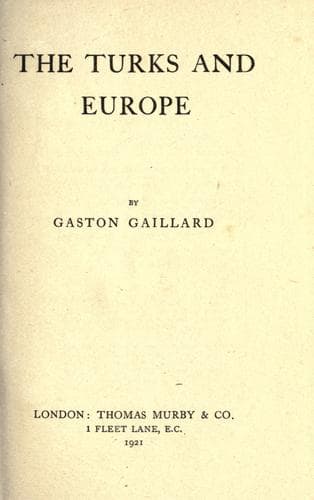
Treaty of Sèvres (1920); World War, 1914-1918 -- Territorial questions -- Turkey; World War, 1914-1918 -- Turkey
The Arabian tribes and Berber communities of Algeria and Tunis, which
had more or less remained under the suzerainty of the Sultan, were no
longer amenable to him after the French conquest. The Pasha of Egypt,
by setting up as an independent Sovereign, and founding the hereditary
dynasty of the Khedives, deprived the Ottoman dominion of Egypt,
where the Arabs were not very numerous, but had played an important
part in the development of Islam. The Italian conquest took away from
Turkey the last province she still owned in Africa. Finally, when the
late war broke out, England deposed the Khedive Abbas Hilmi, who was
travelling in Europe and refused to go back to Egypt. She proclaimed
her protectorate over the Nile valley, and, breaking off the religious
bond that linked Egypt with the Ottoman Empire, she made Sultan of
Egypt, independent of the Sultan of Constantinople, Hussein Kamel,
uncle of the deposed Khedive, who made his entry into Cairo on December
20, 1914.
The Turks, however, kept possession of the Holy Places, Mecca and
Medina, which they garrisoned and governed. This sovereignty was
consolidated by the railway of the pilgrimage. The investiture of the
Sherif of Mecca was still vested in them, and they chose the member of
his family who was to succeed him, and who was detained as a hostage
at Constantinople. But after the failure of the expedition against the
Suez Canal during the late war, and at the instigation of England, the
Sherif, as we shall see, proclaimed himself independent, and assumed
the title of Melek, or King of Arabia.
On the other hand, the province of the Yemen, lying farther south
of the Hejaz, has always refused to acknowledge the authority of
Constantinople, and is practically independent. Lastly, at the southern
end of the Arabian peninsula, the English have held possession of Aden
since 1839, and have extended their authority, since the opening of the
Suez Canal in 1869, over all the Hadramaut. All the sheiks of this part
of Arabia along the southern coast, over whom the authority of Turkey
was but remotely exercised and was practically non-existent, naturally
accepted the protectorate of England without any difficulty, in return
for the commercial facilities she brought them and the allowances
she granted them, and in 1873 Turkey formally recognised the English
possession of this coast.
On the eastern coast of the Arabian peninsula the territory of the
Sultan of Oman, or Maskat, lying along the Persian Gulf, has been
since the beginning of the nineteenth century under the authority
of the Viceroy of India. This authority extends nowadays over all
the territories lying between Aden and Mesopotamia, which are in
consequence entirely under English sway.
Moreover, the English have proclaimed their protectorate over the Sheik
of Koweit.
Public-domain text, read in full here on John Shaqi.
Reviews
Reviews
No reviews yet
Be the first to share your thoughts on this work.
Elsewhere in the archive
Join the Discussion
Join the discussion
Sign in to leave a comment or review.
Sign InorCreate an account