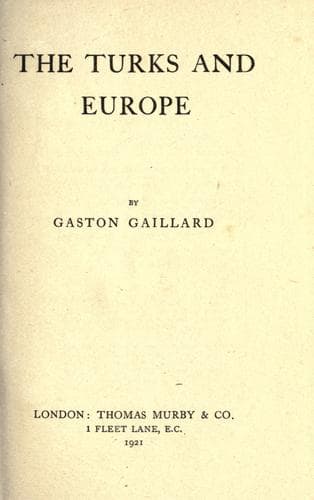
Treaty of Sèvres (1920); World War, 1914-1918 -- Territorial questions -- Turkey; World War, 1914-1918 -- Turkey
“1. The meeting enters a protest against the right the Syrian
Congress has assumed of disposing of Lebanon, of laying down its
frontiers, of restricting its independence, and of forbidding it to
collaborate with France.
“2. The Congress asserts the independence of Lebanon. In the
demarcation of its frontiers, allowance should be made for its
vital necessities and the claims repeatedly expressed by the
populations.
“3. The Congress considers as null and void the decisions taken by
the Damascus Congress concerning Syria, as the latter Congress was
never regularly constituted.
“4. The Congress confirms the mandate given to the delegates sent
by Lebanon who are now in Paris.
“5. The Congress confirms the independence of Greater Lebanon with
the collaboration of France.
“6. The Congress expresses the wish that a Commission consisting
of inhabitants of Lebanon will lay the foundation of the future
constitution of Lebanon, which is to replace the protocol of 1860.
“7. The Congress asserts the Union of Lebanon and France; the
national emblem shall be the tricolour with a cedar on the white
part.”
This opposition was supported by the Maronite archbishops of the sanjak
of Tripolis, Latakia, Hama, and Homs, who sent a telegram of protest
from Tripolis to Syria on March 13. Thus the Arabian movement also met
with Christian opposition.
Khyatin Saffita Tabez Abbas, chief of the Alawite tribe, sent the
following protest from Tartus to the Peace Conference:
“Without the consent of the Alawite tribes, the Emir Feisal has
had himself proclaimed King of Syria. We protest energetically
against such illegal proceedings. We want an Alawite Confederation
established under the direct and exclusive protectorate of France.”
Of course, it was urged that the Assembly of the Syrian Congress at
Damascus included only extremists who worked hand in hand with the
Turkish Nationalists; it seems, nevertheless, that it represented the
opinions of most Syrians, who wanted to restore the unity of Syria; and
their wish was no doubt connected with the wish that was gaining ground
to restore the unity of Arabia.
On the other hand, the Anglo-French treaty, which aimed at a partition
of Ottoman Arabia so as to balance French and English interests, but
disregarded the wishes of the peoples, could not but rouse a feeling
of discontent. Moreover, some Anglo-Egyptian agents and some British
officers had foolishly supported this movement in order to cripple
French influence, feeling quite confident they could check this
movement later on and put Syria under their own suzerainty. But they
were soon thrust aside by the movement, which had been fostered by them
in India and now logically was turning against them.
The Arabs of the interior of Arabia also addressed a proclamation to
General Gouraud stating they welcomed the French as friends, but did
not want them as masters and conquerors.
Public-domain text, read in full here on John Shaqi.
Reviews
Reviews
No reviews yet
Be the first to share your thoughts on this work.
Elsewhere in the archive
Join the Discussion
Join the discussion
Sign in to leave a comment or review.
Sign InorCreate an account