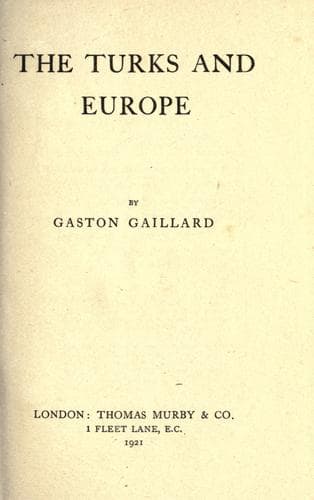
Treaty of Sèvres (1920); World War, 1914-1918 -- Territorial questions -- Turkey; World War, 1914-1918 -- Turkey
“They met him over and over again in London and Paris, and when the
question came of giving the mandate, on two occasions the British
and French Governments sent a joint invitation to the Emir Feisal
to come to Europe and discuss the question with them. The Emir
Feisal was not able to come for one reason or another on either
occasion; but he did say that no case of any ally or anyone in
connection with the Peace Treaty was considered more thoroughly
than his, or with more inclination to meet his wishes. The House
must be under no misapprehension. There was great trouble in the
Middle East. Arab fighting would add to that trouble, and what
happened in Syria must have reflex action in Mesopotamia. If it
was assumed, as some hon. members were ready to assume, that we in
Mesopotamia were pursuing solely selfish aims with no other object,
and if they assumed that the French were pursuing imperialistic
aims in Syria with no other object, then, of course, the case was
hopeless. There was no Frenchman who had shown a broader mind
and a greater readiness to grasp the position of other people
than General Gouraud. In any degree to reflect upon the French
Government in this matter was a very serious thing.”
The time seemed very badly chosen indeed for such a debate in the
English Parliament, as Mr. Winston Churchill, War Secretary, had just
informed the Commons that important reinforcements coming from India
had recently been dispatched to Mesopotamia, and the Commander-in-Chief
had been given full powers to take any measures the situation might
require.
It was the policy of England in the East which stood responsible for
such a state of things. Though the bulk of public opinion in France
was averse to any military action in the East, either in Syria or in
Turkey, yet France was driven to fight, as it were, by England—though
both Governments were supposed to act jointly in the East—in order to
prevent her ally from undermining her influence. Such was the outcome
of England’s ill-omened policy, who first had supported the Arabian
movement and now seemed to forsake it, and thus had roused all the East
against Europe through the resentment caused by her attitude towards
Turkey and Persia. Perhaps England was not very sorry, after all, that
France should divert against herself part of the Arabian forces from
the Mesopotamian front, where the British effectives were insufficient
in number.
Public-domain text, read in full here on John Shaqi.
Reviews
Reviews
No reviews yet
Be the first to share your thoughts on this work.
Elsewhere in the archive
Join the Discussion
Join the discussion
Sign in to leave a comment or review.
Sign InorCreate an account