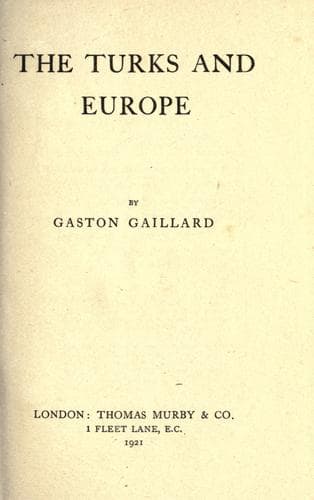
Treaty of Sèvres (1920); World War, 1914-1918 -- Territorial questions -- Turkey; World War, 1914-1918 -- Turkey
So it is a mistake to speak of the ambitious designs of Islam, and the
mistake has been made wilfully. Those who profess such an opinion are
Pan-Slavic Russians who want to deceive public opinion in the world as
to their true intent, and thus prepare for territorial annexations,
because Pan-Slavism is the enemy of Islamism. As this Pan-Slavism has
always been, and is still more than ever, a danger to Europe, it is
the interest of the latter, in order to defend its civilisation, not
to fight against Islamism, but even to support it. This necessity has
been understood by many Catholics who have always been favourable to
Turkey and by the Mussulmans, which accounts for the long friendly
intercourse between Moslems and Catholics, and the Moslems’ tolerance
toward the devotees of a religion which, on the whole, is in complete
contradiction to their own faith. On the other hand, Islam appears as
counterbalancing Protestantism in the East, and it seems the future
of thought and morality and of any culture would be endangered if the
60 million Indian Moslems and the 220 million Indian Brahminists,
Buddhists, and the members of other sects ever listened to Mr. Lloyd
George and were connected with Protestantism.
Moreover, King Hussein, in the course of the audience that he granted
in July, 1920, to Prince Ruffo, the leader of the Italian mission
to Arabia, before his departure, after saying that the Moslem world
resented the hostile attitude of the Powers towards the Sultan of
Constantinople, declared that the Moslems are not actuated by any
feeling of conquest or proselytism, but simply claim the right to
preserve their independence.
Footnotes:
36: _Hayassdan_, July 6, 1915; No. 25.
37: We are the more anxious to correct these figures as in 1916,
at a time when it was difficult to control them, we gave about
the same figures in a note to the Société d’Anthropologie as to
the demographic consequences of the war. We then relied upon the
documents that had just been published and on the statements of the
Rev. Harold Buxton.
38: _Le Mouvement pan-russe et les Allogènes_ (Paris, 1919).
39: _The Times_, March 15, 1920.
40: H. Vambéry. _Cagataische Sprachstudien_ (Leipzig, 1867);
_Etymologisches Wörterbuch der Turko-Tatarischen Sprachen_
(Leipzig, 1875); _Das Turkenvolk_ (1885).
41: Léon Cahun, _Introduction à l’histoire de l’Asie, Turcs et
Mongols, des origines à 1405_ (Paris, 1896).
42: Liman von Sanders, _Fünf Jahre Türkei_, pp. 330-331.
43: _Le Temps_, July 21, 1920.
VIII
THE MOSLEMS OF THE FORMER RUSSIAN EMPIRE AND TURKEY
The Supreme Council, in the course of one of its last sittings,
decided in January, 1920, practically to recognise the independence of
Georgia,[44] Azerbaïjan, and Armenia.
It is deeply to be regretted that this decision came so late, for,
considering the circumstances under which it was taken, it seemed to
have been resorted to _in extremis_ and under the Bolshevist threat.
Public-domain text, read in full here on John Shaqi.
Reviews
Reviews
No reviews yet
Be the first to share your thoughts on this work.
Elsewhere in the archive
Join the Discussion
Join the discussion
Sign in to leave a comment or review.
Sign InorCreate an account