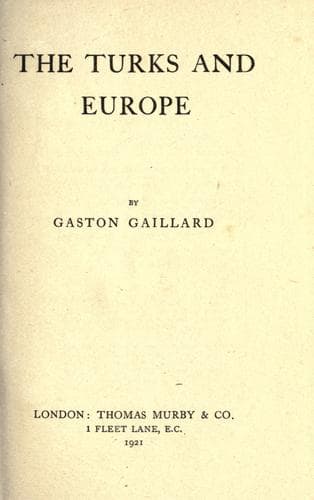
Treaty of Sèvres (1920); World War, 1914-1918 -- Territorial questions -- Turkey; World War, 1914-1918 -- Turkey
It was even announced, then denied, that the Allies were going to send
contingents to the Caucasus in order to check the Bolshevist advance
towards Armenia, Turkey, Persia, and possibly towards Mesopotamia and
India. But under the present circumstances, the Allies were not likely
now to get all the benefit they might have derived from this measure if
it had been taken long ago; and, on the other hand, this measure was
not likely to produce any effect if the new States were not recognised
definitely and could not rely on the Allies’ moral and material support.
Since Georgia, Azerbaïjan, and Armenia seemed to have been recognised
as independent States, in order to incite them to check the Reds’
advance, how was it that the Republic of Northern Caucasus had not been
treated similarly? The reason given by the Supreme Council was that, as
the greater part of this State was occupied by Denikin’s forces, it did
not think it proper to take a decision about it. The true reason was
that the Supreme Council wanted to favour the Pan-Russian general, and
it was even rumoured that Koltchak and Denikin had demanded this rich
country to be set aside for the Tsar, whom they wanted to restore to
the throne.
Out of the 25 or 30 million Moslems living in the whole of Russia, 6
or 8 millions were scattered in the region of the Volga (Orenburg,
Kazan) and in the Crimea; they were about 6 millions in Turkistan
and 7 millions in the Caucasus region; about 2 millions in Northern
Caucasus, 300,000 to 500,000 in Kuban, 600,000 in Georgia, 3,500,000 in
Azerbaïjan. Half the population is Moslem in the new Armenian State,
for only in two districts are the Armenians in a majority, the Tatars
being in a majority in the others. It should be borne in mind that all
these Moslems, after the downfall of Tsardom, had turned their hopes
towards the Allies, especially England, to safeguard their political
independence. Unfortunately neither Great Britain nor France paid any
heed to the repeated entreaties of M. Haidar Bammate, then Minister of
Foreign Affairs of the Republic of Northern Caucasus, or later on to
the appeals of the Georgian statesmen.
Public-domain text, read in full here on John Shaqi.
Reviews
Reviews
No reviews yet
Be the first to share your thoughts on this work.
Elsewhere in the archive
Join the Discussion
Join the discussion
Sign in to leave a comment or review.
Sign InorCreate an account