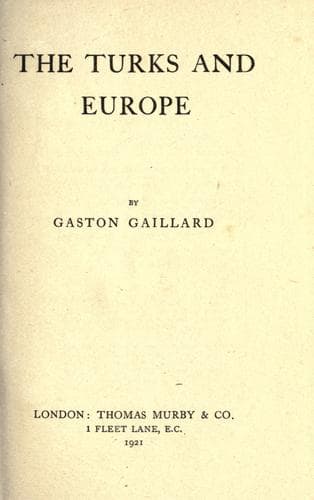
Treaty of Sèvres (1920); World War, 1914-1918 -- Territorial questions -- Turkey; World War, 1914-1918 -- Turkey
Owing to the intervention of Austria, which was averse to a war with
France, the question of Egypt was only settled on July 13, 1841, by
a hatti-sherif, which gave Mehemet Ali the hereditary possession of
Egypt, and by the treaty of London, which guaranteed the neutrality
of the Straits, as Russia wanted to control the Straits and conquer
Constantinople to free the Christians in the Balkan Peninsula from
the so-called Ottoman tyranny, and “relight the tapers which had been
put out by the Turks” in St. Sophia, restored to Orthodoxy. France,
following the old traditions of her foreign policy and in agreement
with England, confined the Russians within the Black Sea by the
convention of the Straits in 1841, and thus secured, not the integrity,
but the existence of the Turkish Empire.
But the Tsar, Nicholas I, who was bent on defending the Greek faith
within the Ottoman Empire, was anxious to see Turkey pursue the work
of the Tanzimat—_i.e._, the new régime—confirmed by the promulgation
by Abdul Mejid of the hatti-sherif of Gulhané on November 3, 1839. In
1844 he made overtures concerning the partition of Turkey, to England,
to which the latter country turned a deaf ear. Thanks to the support of
Great Britain and France, the Turkish troops, which had been sent to
Moldavia and Wallachia after the riots which had broken out after the
revolution, compelled the Tsar in 1849-51 to withdraw his army beyond
the Pruth.
In 1850 France protested against the encroachments of Russia in the
East, who, in order to protect the Greek monks living in Palestine and
secure her own religious domination, wanted to deprive the Roman monks
of their time-honoured rights over the Christian sanctuaries.
Public-domain text, read in full here on John Shaqi.
Reviews
Reviews
No reviews yet
Be the first to share your thoughts on this work.
Elsewhere in the archive
Join the Discussion
Join the discussion
Sign in to leave a comment or review.
Sign InorCreate an account