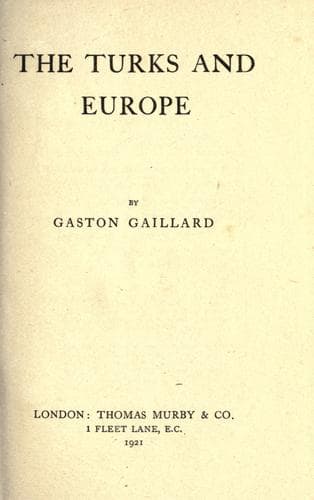
Treaty of Sèvres (1920); World War, 1914-1918 -- Territorial questions -- Turkey; World War, 1914-1918 -- Turkey
In 1853 the Tsar sent Prince Menshikov to Constantinople in order to
demand a formal treaty granting the Greek Church religious independence
and temporal privileges. The Sublime Porte, backed by France and
England, rejected the ultimatum. The latter Powers then sent a
fleet to the Dardanelles, and the next month—on July 4, 1853—Russia
occupied Moldavia and Wallachia. At the instigation of Austria, the
Powers assembled at Vienna on the 24th of the same month drew up a
conciliatory note, which was rejected by Russia. Then the English
fleet sailed up the Dardanelles, and on October 4 Turkey declared war
on Russia. Austria tried again, at the Vienna Conference which she
reopened in December, 1853, to bring about an understanding between
Russia and Turkey. But Nicholas I declared that he meant to treat
only with England and Prussia to restore peace in the East, which
Turkey looked upon as an affront. He also rejected Napoleon III’s
mediation on January 29, 1854, and the Franco-English summons on
February 27, upon which France declared war on him. Notwithstanding
the political views which unfortunately are still held by most of the
present diplomatists, and in pursuance of which the Powers had already
checked Mehemet Ali’s success and prevented Turkey resuming her former
state, France and England realised the dangerous consequences of the
Russian threat and backed Turkey. In consequence of the manœuvres of
Austria and the unwillingness of Prussia, who had declared “she would
never fight against Russia,” the Allies, who were at Varna, instead
of attacking the principalities, decided to launch into the Crimean
expedition. Finally, after the ultimatum drawn up by Austria, to which
the Emperor Alexander submitted at the instigation of Prussia, a treaty
of peace signed in Paris on March 30, 1856, recognised the integrity
of Turkey, abolished the Russian protectorate over the principalities,
and guaranteed the independence of Serbia, Moldavia, and Wallachia,
under the suzerainty of the Ottoman Empire. Our diplomats seem then
to have partly realised the extent of the danger constituted by the
Slavs, and to have understood that the Turks, by driving back the Slavs
and keeping them away from Western and Mediterranean Europe since the
fourteenth century, had enabled Western civilisation to develop.
As the influence of France in Turkey was imperilled after her defeat
in 1870, Russia took advantage of this to declare she would no longer
submit to the most important clauses of the London treaty of March
13, 1871. Russia, whose ambassador in Turkey at that time was General
Ignatiev, took in hand the cause of the independence of the Bulgarian
Church, for which, in 1870, she had obtained the creation of a national
exarchate with its own hierarchy, which had exasperated the Phanar at
Constantinople and brought about deadly encounters between Turks and
Bulgarians.
Public-domain text, read in full here on John Shaqi.
Reviews
Reviews
No reviews yet
Be the first to share your thoughts on this work.
Elsewhere in the archive
Join the Discussion
Join the discussion
Sign in to leave a comment or review.
Sign InorCreate an account