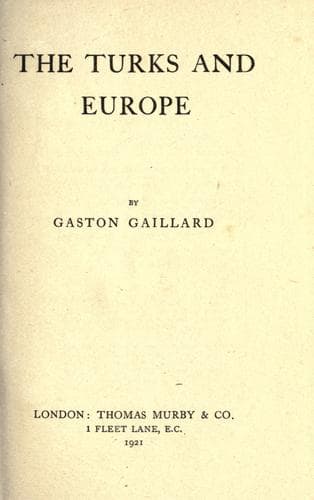
Treaty of Sèvres (1920); World War, 1914-1918 -- Territorial questions -- Turkey; World War, 1914-1918 -- Turkey
Unfortunately, the Marquis de Villeneuve, Louis XV’s ambassador, and
the Comte de Bonneval, who had been converted to Islam, had been
the last Frenchmen who had supported the Sublime Porte against the
Russian Tsar’s hostility and endeavoured to use Islam as the protector
of the liberty of peoples imperilled by the Tsars; and yet this old
policy of France had the advantage both of benefiting French trade and
counterbalancing the power of the enemies of France.[46] On the other
hand, at the Congress of Sistovo in 1791, Sir Robert Murray Keith, who
acted as mediator in the conclusion of the Austro-Turkish treaty of
peace, recommended his fellow-countrymen “to let the Turks dwindle
down in their own dull way.” So now French policy and English policy
were going the same way.
During the reign of Charles X, the Polignac Cabinet was willing to
sacrifice Constantinople to the Russians in return for the left bank
of the Rhine, and in 1828 Chateaubriand, French ambassador at Rome,
favoured an alliance with the Tsar in order to obtain the revision of
the 1815 treaties, at the cost of Constantinople. Moreover, Admiral Sir
Edward Codrington, by destroying the Turco-Egyptian fleet at Navarino
on October 20, 1827, with the combined fleets of Great Britain, France,
and Russia, furthered the Russian Tsar’s plans.
As the direct capture of the Straits was bound to raise diplomatic
difficulties, Nicholas I, on September 4, 1892, summoned a secret
council to discuss what policy Russia was to pursue on this point.
The opinion which prevailed was expressed in a memorandum drawn up
by a former diplomatist, Dimitri Dashkov, then Minister of Justice,
and in a draft partition of the Turkish Empire penned by a Greek,
Capodistria. This secret committee, dreading the opposition of the
Western States, decided to postpone the partition lest, as Great
Britain and France refused their consent, it should not finally benefit
the designs of Russia and Greece on Constantinople. These secret
debates have been summed up in a book published in 1877;[47] and M.
Goriainov, in the book he wrote on this question in 1910,[48] thought
it proper to praise the consistent magnanimity of the Tsars towards the
Turks—whereas the policy which maintained that no reforms would ever
be instituted by Turkey of her own free-will if they were not urged
on by diplomatic intrigues or international interference, and that
“the sick man” could only be restored to health by the intervention of
Christendom and under the Orthodox tutelage, was the real cause of the
decay of Turkey and the origin of all the intricacies of the Eastern
problem.
Public-domain text, read in full here on John Shaqi.
Reviews
Reviews
No reviews yet
Be the first to share your thoughts on this work.
Elsewhere in the archive
Join the Discussion
Join the discussion
Sign in to leave a comment or review.
Sign InorCreate an account