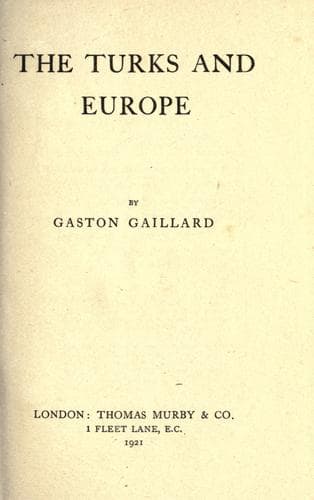
Treaty of Sèvres (1920); World War, 1914-1918 -- Territorial questions -- Turkey; World War, 1914-1918 -- Turkey
“The possession of the Straits is of vital interest to the Empire
and far exceeds in importance all the territorial advantages
Russia might obtain at the expense of Germany and Austria.... The
neutralisation of the Bosphorus and the Dardanelles would be an
unsatisfactory, mongrel compromise, pregnant with dangers for the
future.... Constantinople must be a Russian town.... The Black Sea
must become a Russian lake.”[52]
In the formal statement of the Government policy read on February 9,
1915, at the opening of the Duma, after mention had been made of the
victories gained by the Russian armies over Turkey, the following
sentence occurred: “Brighter and brighter does the radiant future of
Russia shine before us in yonder place, on the shores of the sea which
washes the battlements of Constantinople.”
Sazonov only hinted at the question of the Straits in the speech which
followed, but he declared: “The day is drawing near when the economic
and political problems arising from the necessity for Russia to have
free access to the open sea will be solved.”
Evgraf Kovalevsky, deputy of Moscow, stated in his turn: “The Straits
are the key of our house, so they must be handed over to us, together
with the Straits area.”
Then, M. Miliukov, after thanking M. Sazonov for his declaration,
concluded his speech in these terms:
“We are happy to hear that our national task will soon be
completed. We now feel confident that the possession of
Constantinople and the Straits will be ensured in due time, through
diplomatic and military channels.”
The question of Constantinople captivated public opinion at that time,
and in February, 1915, it engrossed the minds of all prominent men in
Russia. Public feeling agreed with the declarations we have just read,
that a victorious peace must give Constantinople to Russia.
At the beginning of March, M. Sazonov could not refrain from raising
this question with the ambassadors of France and Great Britain, and
asked them to give him an assurance that the Governments of London and
Paris would consent after the war to the annexation of Constantinople
by Russia.[53]
On March 3, at the dinner given in honour of General Pau, Nicholas
II talked on the same subject to M. Paléologue. The Emperor, after
recalling the conversation he had had with him in November of the
previous year, in the course of which he had said France could rely
upon Russia, and telling him he had not altered his mind, said:
Public-domain text, read in full here on John Shaqi.
Reviews
Reviews
No reviews yet
Be the first to share your thoughts on this work.
Elsewhere in the archive
Join the Discussion
Join the discussion
Sign in to leave a comment or review.
Sign InorCreate an account