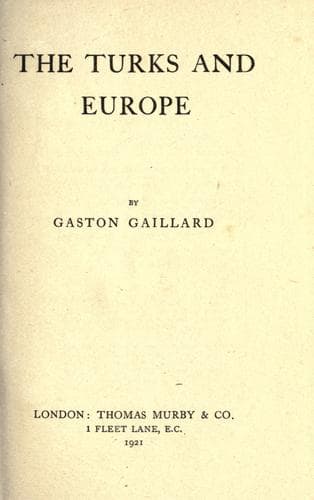
Treaty of Sèvres (1920); World War, 1914-1918 -- Territorial questions -- Turkey; World War, 1914-1918 -- Turkey
The new policy pursued by France towards Turkey becomes the more
surprising—coming after her time-honoured Turkish policy and after the
recent mistakes of her Russian policy—as we see history repeat itself,
or at least, similar circumstances recur. Even in the time of the
Romans the events of Syria and Mesopotamia were connected with those of
Central Europe; as Virgil said: “Here war is let loose by Euphrates,
there by Germany.” Long after, Francis I, in order to check the
ambitious designs of Charles V, Emperor of Germany, who, about 1525,
dreamt of subduing the whole of Europe, sought the alliance of Soliman.
The French king, who understood the Latin spirit so well and the great
part it was about to play in the Renaissance, had foreseen the danger
with which this spirit was threatened by Germany.
Moreover, a recent fact throws into light the connection between the
German and Russian interests in the Eastern question, and their similar
tendencies. For Marshal von der Goltz was one of the first to urge
that the Turkish capital should be transferred to a town in the centre
of Asia Minor.[60] Of course, he professed to be actuated only by
strategic or administrative motives, for he chiefly laid stress on the
peculiar geographical situation of the capital of the Empire, which,
lying close to the frontier, is directly exposed to a foreign attack.
But did he not put forward this argument merely to conceal other
arguments which concerned Germany more closely? Though the Germans
professed to be the protectors of Islam, did not the vast Austro-German
schemes include the ejection of the Turks from Europe to the benefit of
the Slavs, notwithstanding the declarations made during the war by some
German publicists—M. Axel Schmidt, M. Hermann, M. Paul Rohrbach—which
now seem to have been chiefly dictated by temporary necessities?
Thus the Turkish policy of the Allies is the outcome of their Russian
policy—which accounts for the whole series of mistakes they are still
making, after their disillusionment with regard to Russia.
For centuries, Moscow and Islam have counterpoised each other: the
Golden Horde having checked the expansion of Russia, the latter did
her best to bring about the downfall of the Ottoman Empire. It had
formerly been admitted by the Great Powers that the territorial
integrity of the Ottoman Empire should not be infringed upon, for it
was the best barrier to Russia’s claims on the Straits and her advance
towards India. But after the events of the last war, England, reversing
her traditional policy, and the Allies, urged on by Pan-Russian
circles, have been gradually driven to recognise the Russian claims to
Constantinople in return for her co-operation at the beginning of the
war.
Public-domain text, read in full here on John Shaqi.
Reviews
Reviews
No reviews yet
Be the first to share your thoughts on this work.
Elsewhere in the archive
Join the Discussion
Join the discussion
Sign in to leave a comment or review.
Sign InorCreate an account