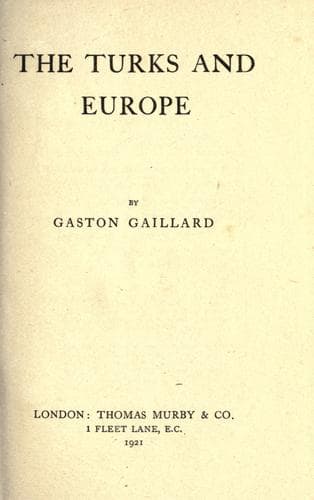
Treaty of Sèvres (1920); World War, 1914-1918 -- Territorial questions -- Turkey; World War, 1914-1918 -- Turkey
The outcome of this policy of the Allies has been to drive both the
new States, whose independence they persistently refused to recognise,
and the old ones, whose national aspirations they did not countenance,
towards Bolshevism, the enemy of the Allies; it has induced them,
in spite of themselves, to come to understandings with the Soviet
Government, in order to defend their independence. England in this way
runs the risk of finding herself again face to face with Russia—a new
Russia; and thus the old Anglo-Russian antagonism would reappear in
another shape, and a more critical one. Sir H. Rawlinson[61] denounced
this danger nearly half a century ago, and now once more, though in a
different way, “India is imperilled by the progress of Russia.”
However, there is no similarity between Pan-Turanianism and Bolshevism,
though an attempt has been made in press polemics or political
controversies to confound the one with the other. They have no common
origin, and the utter incompatibility between Bolshevism and the spirit
of Western Europe exists likewise to another extent and for different
reasons between Bolshevism and the spirit of the Turks, who, indeed,
are not Europeans but Moslems, yet have played a part in the history of
Europe and thus have felt its influence. The Turks—like the Hungarians,
who are monarchists and have even sought to come to an understanding
with Poland—have refused to make an alliance with the Czecho-Slovaks,
who have Pan-Slavic tendencies; and so they cannot become Bolshevists
or friendly to the Bolshevists. But, if the Allies neither modify their
attitude nor give up the policy they have pursued of late years, the
Turks, as well as all the heterogeneous peoples that have broken loose
from old Russia, will be driven for their own protection to adopt
the same policy as new Russia—the latter being considered as outside
Europe; and thus the power of the Soviet Government will be reinforced.
We have been among the first to show both the danger and the inanity of
Bolshevism; and now we feel bound to deplore that policy which merely
tends to strengthen the Bolshevists we want to crush. Our only hope is
that the influence of the States sprung from old Russia or situated
round it on Soviet Russia—with which they have been obliged to come
to terms for the sake of self-defence—will complete the downfall of
Bolshevism, which can only live within Russia and the Russian mind,
but has already undergone an evolution, owing to the mistakes of the
Allies, in order to spread and maintain itself.
As to the dismemberment of the Ottoman Empire, it seems that far from
solving the Eastern question, it is likely to bring about many fresh
difficulties, for it is a political mistake as well as an injustice.
Public-domain text, read in full here on John Shaqi.
Reviews
Reviews
No reviews yet
Be the first to share your thoughts on this work.
Elsewhere in the archive
Join the Discussion
Join the discussion
Sign in to leave a comment or review.
Sign InorCreate an account