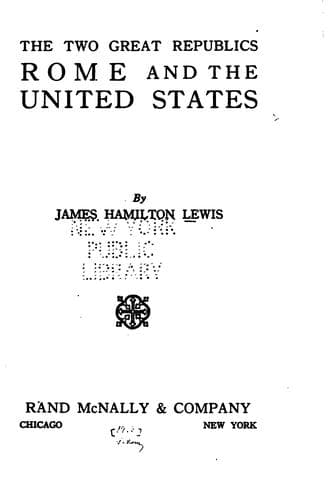
The Two Great Republics: Rome and the United StatesLewis, James
History
The Two Great Republics: Rome and the United States
Lewis, James
Rome -- Politics and government -- 510-30 B.C.; United States -- Politics and government
It is always one of the most difficult of tasks to persuade the
citizens of any republic that any political leader is actually
planning the overthrow of the republican form of government. This
blindness, not restricted to any one race or age, was so dense at this
time in Rome that many people had refused to believe even in the
existence of the conspiracy of Catiline, and had suspected Cicero of
having invented the whole story with the object of making political
capital for himself.
The fierce fire in the Senate of the oration by Cicero against
Catiline, however, proved sufficient to force Catiline to action; and
the night after Cicero's first oration against him Catiline fled to
Tuscany to join the forces which had been collected there under his
lieutenant Manlius. Catiline, keeping up his deceit and duplicity to
the end, even while en route to the army of the conspirators wrote
letters to Rome declaring that he was the victim of a conspiracy and
that his present purpose was to go into voluntary banishment at
Marseilles.
Upon reaching his army Catiline threw off the mask and prepared to
take active steps for the overthrow and destruction of Rome. The
conspiracy had now passed the point where it was merely intended to
overthrow the duly elected Roman officials, and to install Catiline
and his friends in their places; the conspirators now sought nothing
less atrocious than the sack of Rome and the murder of her wealthiest
citizens. The contest had now become one directed against the rich
class of the nobles by the poor and bankrupt members of the same
order, assisted by all the unprincipled and desperate adventurers of
Italy.
The plans of Catiline and his supporters were that the army in Tuscany
should march upon Rome, while the friends of Catiline in the city
should watch for a favorable opportunity to murder the consuls and set
fire to the city.
To meet this two-sided danger Antonius was sent with an army against
Catiline, while Cicero remained in Rome to secure the safety of the
city. Cicero was the first to complete his part of the work. The
untiring efforts of the consul at length resulted in securing legal
proof against the leading conspirators who had remained at Rome, and
these were immediately arrested and brought to trial. The people were
at length convinced of the truth of the conspiracy, but even now it
was only with the greatest difficulty that Cicero was able to have
the death sentence decreed against the prisoners.
Catiline now attempted to retreat into Gaul, but was pursued by
Antonius, and in the battle which ensued the army of Catiline was cut
to pieces and Catiline himself killed.
Public-domain text, read in full here on John Shaqi.
Reviews
Reviews
No reviews yet
Be the first to share your thoughts on this work.
Elsewhere in the archive
Join the Discussion
Join the discussion
Sign in to leave a comment or review.
Sign InorCreate an account