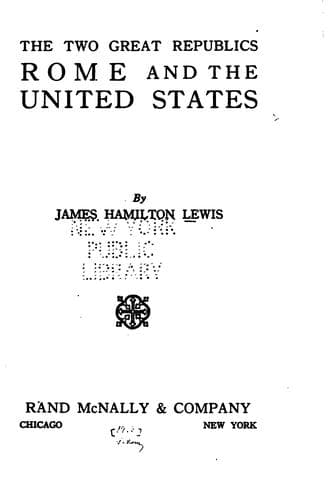
The Two Great Republics: Rome and the United StatesLewis, James
History
The Two Great Republics: Rome and the United States
Lewis, James
Rome -- Politics and government -- 510-30 B.C.; United States -- Politics and government
Cicero had earned the gratitude of Rome by preserving it from its
threatened destruction at the hands of Catiline; but the rest of his
record as consul was not of a very creditable character. Throughout
his year of office Cicero was the consistent champion of the
senatorial party, and the opponent of all measures to improve the
economic conditions of the people. In particular, Cicero is to be
censured for his opposition to the agrarian law proposed at this time.
Cicero was also largely responsible for the defeat of a bill to
restore the right of citizenship to the children of the men who had
been proscribed by Sulla.
CHAPTER XI
JULIUS CÆSAR
It now remains to relate the life history of the man by whom the
republican form of government at Rome was fated to be finally
overthrown. That the existence of this Roman republic was doomed, that
democratic or oligarchical government must give way either to anarchy
or despotism, had been certain ever since the refusal of the Roman
citizens to support the attempted reforms of the Gracchi.
There is no greater obstacle to the complete success of popular
government than the almost inexplicable tendency of the majority of
men to crucify the true reformer and conscientious lover of humanity
as a disturber of, and a menace to, society, and to heap honors upon
the head of the selfish, unprincipled, egotistical, and vicious
demagogue. The result is that the reforms which might save the country
fail; and later the people, at last roused to a realization of the
evils which surround them, grasp at the promises of the imposter and
follow him with hysterical and insane enthusiasm until their false
leader directs their footsteps to the precipice, over which they fall
to their destruction. If France had adopted the moderate reforms of
Necker and Turgot she might have been saved from the terrible
retribution of the French Revolution; if Rome had not rejected the
leadership of Tiberius Gracchus, and later accepted that of Julius
Cæsar, the Roman republic need not have fallen.
Public-domain text, read in full here on John Shaqi.
Reviews
Reviews
No reviews yet
Be the first to share your thoughts on this work.
Elsewhere in the archive
Join the Discussion
Join the discussion
Sign in to leave a comment or review.
Sign InorCreate an account