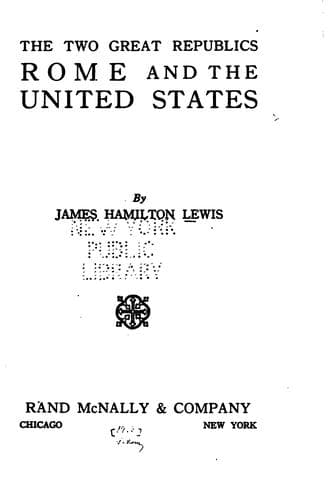
The Two Great Republics: Rome and the United StatesLewis, James
History
The Two Great Republics: Rome and the United States
Lewis, James
Rome -- Politics and government -- 510-30 B.C.; United States -- Politics and government
In 65 B.C. Cæsar was elected ædile. He was obliged to plunge himself
heavily into debt to obtain this office; and after his election he did
not hesitate to go still deeper into debt for the purpose of providing
magnificent shows for the people at the public games. In virtue of the
power of his office Cæsar placed the statue of Marius, surrounded by
the trophies of his Cimbrian and Jugurthine victories, among the new
ornaments of the capitol. At the close of his term as ædile Cæsar
sought to be sent to Egypt for the purpose of forming Egypt into a
Roman province, in accordance with the will of the Egyptian king,
Ptolemy Alexander. This important mission, however, was denied to
Cæsar, to whom was assigned the duty of presiding in the tribunal
which conducted the investigation in cases of suspected murder.
The following year, the year of the consulship of Cicero and the
conspiracy of Catiline, Cæsar passed temporarily under a cloud on
account of his suspected connection with the conspiracy. The suspicion
that Cæsar had at least been privy to the plans of the conspirators
was strengthened by his efforts to prevent the death sentence being
passed against their leaders.
The Roman historian Sallust, in his history of Catiline, has reported
Cæsar's speech in the Senate on this occasion, which serves to
illustrate the craftiness of the man. A portion of this speech is here
inserted:
"In all debates, Conscript Fathers, when the matter under
deliberation is in its nature doubtful, it is the duty of
every senator to bring to the question a mind free from
animosity and friendship, from anger and compassion. When
those emotions prevail, the understanding is clouded, and
truth is scarcely perceived. To be passionate and just at
the same time is not in the power of man. Reason, when
unbiased, and left to act with freedom, answers all our
purposes; when passion gains the ascendant, reason is
fatigued, and judgment lends no assistance.
"In the case now before us, let it be our wisdom, Conscript
Fathers, not to suffer the crimes of Lentulus and his
accomplices to hurry you beyond the bounds of moderation.
Indignation may operate on your minds, but a due sense of
your own dignity, I trust, will preponderate. My opinion is
this; if you know of any pains and penalties adequate to the
guilt of the conspirators, pronounce your judgment; I have
no objection. If you think death a sufficient punishment, I
concur with Silanus; but if the guilt of the prisoners
exceeds all forms of vindictive justice, we should rest
contented with the laws known to the constitution.
Public-domain text, read in full here on John Shaqi.
Reviews
Reviews
No reviews yet
Be the first to share your thoughts on this work.
Elsewhere in the archive
Join the Discussion
Join the discussion
Sign in to leave a comment or review.
Sign InorCreate an account