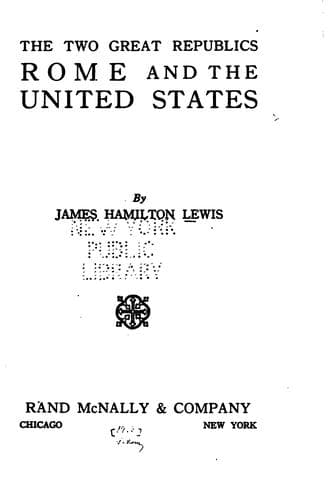
The Two Great Republics: Rome and the United StatesLewis, James
History
The Two Great Republics: Rome and the United States
Lewis, James
Rome -- Politics and government -- 510-30 B.C.; United States -- Politics and government
"The senators who have gone before me have exhausted the
colors of rhetoric, and in a pathetic style have painted
forth the miseries of their country. They have displayed the
horrors of war, and the wretched condition of the
vanquished; the young of both sexes suffering violation;
children torn from the mother's arms; virtuous matrons
exposed to the brutal passions of the conqueror; the houses
of citizens, and the temples of the gods, pillaged without
distinction; the city made a theater of blood and horror; in
a word, desolation and massacre in every quarter.
"But why, immortal gods! why all that waste of eloquence?
Was it to inflame our passions? to kindle indignation? to
excite a detestation of rebellion? If the guilt of these men
is not of itself sufficient to fire us with resentment, is
it in power of words to do it? I answer, No; resentment is
implanted in our hearts by the hand of nature; every man is
sensible of injury and oppression; many are apt to feel too
intensely. But we know, Conscript Fathers, that resentment
does not operate alike in all the ranks of life: he who
dwells in obscurity may commit an act of violence, but the
consequence is confined to a small circle. The fame of the
offender, like his fortune, makes no noise in the world. It
is otherwise with those who figure in exalted stations; the
eyes of mankind are upon them; and the wrong they do is
considered an abuse of power. Moderation is the virtue of
superior rank. In that preëminence, no apology is allowed
for the injustice that proceeds from partiality, from anger,
aversion, or animosity. The injury committed in the lower
classes of life is called the impulse of sudden passion; in
the higher stations, it takes the name of pride and
cruelty....
"With regard to capital punishment, it is a truth well known
that to the man who lives in distress and anguish of heart,
death is not an evil; it is a release from pain and misery;
it puts an end to the calamities of life; and after the
dissolution of the body, all is peace; neither care nor joy
can then intrude....
Public-domain text, read in full here on John Shaqi.
Reviews
Reviews
No reviews yet
Be the first to share your thoughts on this work.
Elsewhere in the archive
Join the Discussion
Join the discussion
Sign in to leave a comment or review.
Sign InorCreate an account