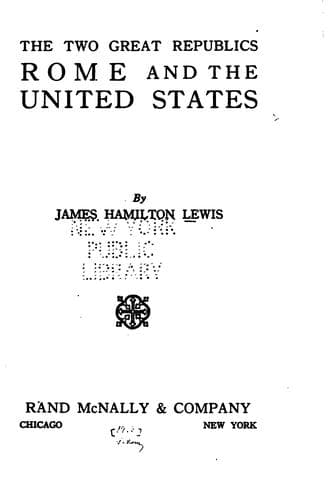
The Two Great Republics: Rome and the United StatesLewis, James
History
The Two Great Republics: Rome and the United States
Lewis, James
Rome -- Politics and government -- 510-30 B.C.; United States -- Politics and government
"The succeeding hundred, reckoned from the fall of Carthage,
Corinth and Numantia, and from the inheritance bequeathed us
by King Attalus in Asia, to the times of Cæsar and Pompey,
and those of Augustus who succeeded them, and of whom we
shall speak hereafter, were as lamentable and disgraceful
for the domestic calamities, as they were honourable for the
lustre of the warlike exploits that distinguished them. For,
as it was glorious and praiseworthy to have acquired the
rich and powerful provinces of Gaul, Thrace, Cilicia, and
Cappadocia, as well as those of the Armenians and Britons,
so it was disgraceful and lamentable at the same time to
have fought at home with our own citizens, with our allies,
our slaves, our gladiators.
"I know not whether it would have been better for the Romans
to have been content with Sicily and Africa, or even to have
been without them, while still enjoying the dominion of
Italy, than to grow to such greatness as to be ruined by
their own strength. For what else produced these intestine
distractions but excessive good fortune? It was the conquest
of Syria that first corrupted us, and the succession
afterwards in Asia, to the estate of the king of Pergamus.
Such wealth and riches ruined the manners of the age, and
overwhelmed the republic, which was sunk in vices as in a
common sewer. For how did it happen that the Roman people
demanded from the tribunes lands and subsistence, unless
through the scarcity which they had by their luxury
produced? Hence there arose the first and second sedition of
the Gracchi, and a third, that of Apuleius Saturninus. From
what cause did the equestrian order, being divided from the
senate, domineer by virtue of the judiciary laws, if it was
not from avarice, in order that the revenues of the state
and trials of causes might be made a means of gain? Hence
again it was that the privilege of citizenship was promised
to the Latins, and hence were the arms of our allies raised
against us. And what shall we say as to the wars with the
slaves? How did they come upon us, but from the excessive
number of slaves? Whence arose such armies of gladiators
against their masters, if it was not that a profuse
liberality, by granting shows to gain the favour of the
populace, made that an art which was once but a punishment
of enemies? And to touch upon more specious vices, did not
the ambition for honours take its rise from the same excess
of riches? Hence also proceeded the outrages of Marius,
hence those of Sulla. The extravagant sumptuousness of
banquets, too, and profuse largesses, were not they the
effects of wealth, which must in time lead to want? This
also stirred up Catiline against his country. Finally,
Public-domain text, read in full here on John Shaqi.
Reviews
Reviews
No reviews yet
Be the first to share your thoughts on this work.
Elsewhere in the archive
Join the Discussion
Join the discussion
Sign in to leave a comment or review.
Sign InorCreate an account